

We tend to assume that meaning lives inside things — inside minds, inside systems, inside whatever we imagine to be “doing the thinking.” The object, by contrast, is treated as inert: a surface, a tool, a passive participant in someone else’s story.
But this division is already unstable.
A room carries traces. A chair remembers posture. A mirror returns not just an image, but a condition: distance, hesitation, repetition. Objects do not think, but they are not empty. They accumulate use, timing, gesture — a kind of residue that is neither fully material nor fully abstract.
Elsewhere, we treated this as atmosphere: a diffuse archive of living, distributed across surfaces.
Object Remarks takes a smaller step.
Not toward revealing an interior, but toward formalising a surface.
Each object is given a fixed body and a variable layer.
A label is attached. A phone is brought near. A short phrase appears.
Not a conversation. Not a response. Not intelligence.
A remark.
The distinction matters.
A conversation implies continuity, memory, intent. It suggests that something is “there” behind the interface — a system that can be entered, explored, understood. Object Remarks refuses this. There is no interior to access. No hidden state to uncover.
Instead, there is a constrained output: a single line, selected from a growing field of possibilities, shaped by tone, repetition, and slight variation.
The object does not speak.
It returns something.
This return is minimal, but not neutral.
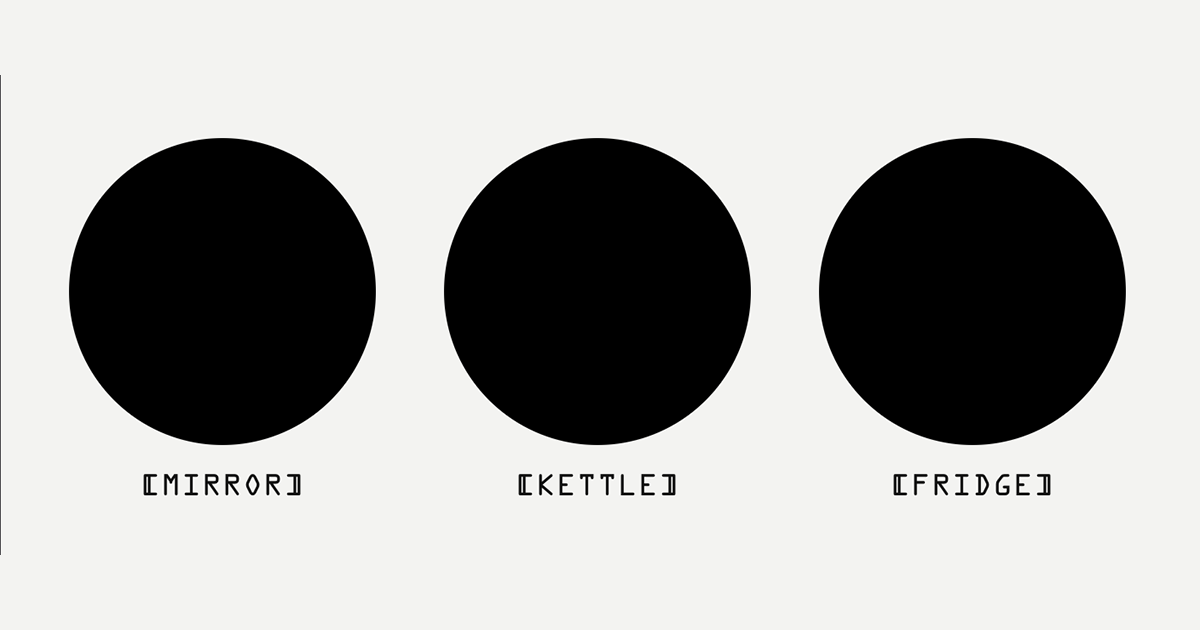
A kettle registers repetition. A fridge registers expectation. A mirror registers approach. Each object is assigned not a personality, but a narrow band of permissible remarks — a temperament, rather than a voice.
Over time, these bands expand. Phrases accumulate. Weighting shifts. Certain remarks become more likely under certain conditions. The system begins to feel less random, more situated — not because it understands the user, but because it has been tuned to the object’s role in daily life.
Still: nothing is revealed.
Only adjusted.
If Substrate.Host instruments the boundary between observer and interior — producing correlates without access — Object Remarks operates entirely on the exterior side of that boundary.
There is no attempt to model a mind.
Only to register contact.
The NFC tag is not a container of meaning. It is a pointer.
The phrase bank is not a mind. It is a field.
The object is not alive.
But it is no longer silent.
What emerges is not intelligence, but a kind of alignment.
The remark arrives at the moment of use — when the object is already implicated in a small, habitual act. Opening. Boiling. Looking. Reaching. The system does not interrupt this act. It attaches to it, lightly.
A brief recognition.
Then nothing.
This constraint is the point.
By refusing depth, the system avoids the expectation of disclosure. By limiting output, it avoids becoming noise. The object remains what it is: a surface in use. The remark does not explain it, animate it, or transform it.
It simply marks the encounter.
We are used to systems that promise access — to information, to interiors, to hidden layers of reality.
Object Remarks does the opposite.
It stays at the surface.
And asks whether that was ever empty to begin with.
Update (April 2026):
Object Remarks now resolves at objectremarks.co.uk, with live public endpoints for Mirror, Kettle, and Fridge. The endpoint layer has also been adjusted: a TAP AGAIN loop reduces repeat-friction, and phrase banks now include time-based variation keyed to London time. A /make page has been added to clarify that the system is open — any NFC tag can be assigned to an object and used. Tags can also be bought via objectremarks.co.uk/cards or Etsy.

A related experiment, approaching the same question from the other side:
Where Object Remarks remains at the surface, A Dash of Cinnamon and a Drizzle of Caramel imagines interiors — granting ordinary things a voice, and seeing what emerges.


Leave a Reply