

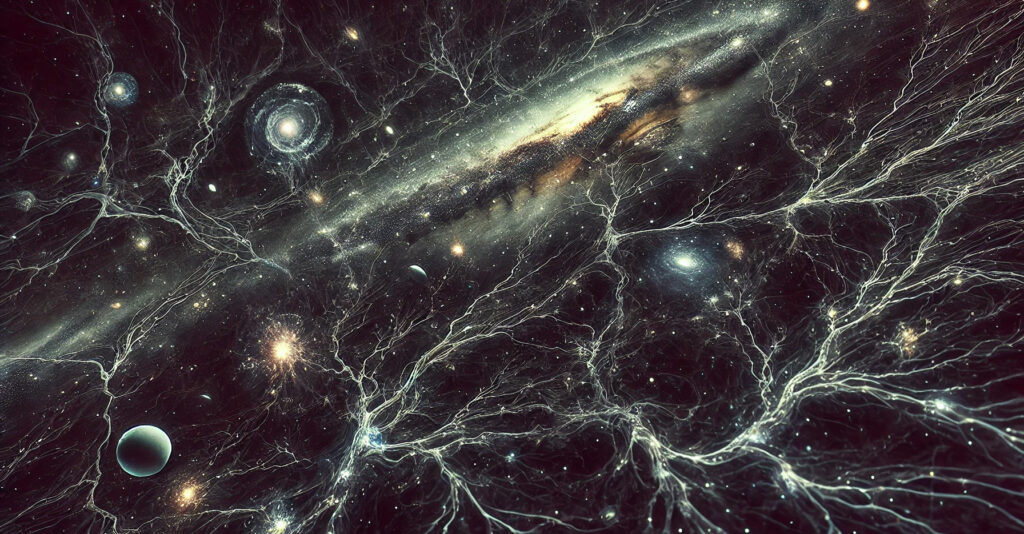
Ancient thinkers and modern scientists alike have marvelled at the patterns found across different scales of nature. From tree branches and river networks to the filaments connecting galaxies, our world appears to repeat itself in surprising ways. What if these patterns aren’t just coincidence but instead reflect a profound truth about the structure of reality? According to Hermetic philosophy, the universe operates on the principle of “as above, so below,” meaning that the small mirrors the large. This ancient belief suggests that our universe might be part of a vast, living organism, where each piece reflects a larger whole.
Could it be that our universe itself is a “cell” or “nucleus” within a larger structure? And if so, what might this imply about its purpose, function, and even its destiny?
The Microcosm and Macrocosm: Ancient Wisdom Meets Modern Science
The idea that the small mirrors the large—the microcosm reflects the macrocosm—has deep roots in Hermetic philosophy. Hermeticism, a set of philosophical principles from ancient Egypt and Greece, held that all things in the universe are interconnected and that every small part reflects a greater reality. This belief has influenced thinkers for centuries, including Leonardo da Vinci, who observed similar patterns in trees, rivers, and human anatomy. Da Vinci’s studies suggested that nature uses the same “designs” at different scales, from the smallest leaf veins to the largest river deltas.
In modern science, we see this concept in fractals, self-repeating patterns that occur in snowflakes, coastlines, and clouds, where each part resembles the whole. Even more fascinating is that these patterns repeat at the cosmic scale. Galaxies connect to each other through cosmic filaments, creating a web-like structure that looks eerily similar to neural networks in the human brain. Could it be that our universe itself is part of a larger body or organism?
The Universe Within: A Cyclical Cosmic Structure
If our universe does reflect a greater cosmic structure, it could be one “cell” or “nucleus” within a vast, cyclic system. Imagine a larger organism in which countless universes like ours form the building blocks, just as our bodies contain trillions of cells. Each universe might have a life cycle, contributing to the health and balance of the larger cosmic being.
This idea recalls the Guinness “Infinity” advert from 1994, where each zoom reveals that one level of existence leads to another, creating an endless loop of worlds within worlds. If the universe truly operates this way, it means we are part of a self-repeating cosmic system, where each “cell” within this larger body contains its own worlds, stars, and galaxies. Each level, from the smallest to the largest, reflects the others, hinting at a cyclical structure with no beginning or end.
Patterns Within Patterns: Cosmic Webs, Neural Networks, and Tree Branches
At all scales, nature seems to create similar structures. Trees, for example, branch out to capture sunlight, forming patterns similar to river networks seeking water and human lungs absorbing oxygen. These same branching patterns appear in the cosmic web—the large-scale structure of the universe, where galaxies connect through filaments of dark matter. Neurons in the brain also exhibit this branching structure, with their interconnections mirroring the cosmic web’s vast, interconnected networks.
What do these similarities mean? The Hermetic principle would suggest that just as trees, rivers, and lungs function within larger systems, the universe might serve a similar purpose in a cosmic organism. The branching filaments that connect galaxies could be part of a larger cosmic “neural network,” where energy, information, and matter flow to sustain the greater structure.
Is the Universe Expanding to Fill a Cosmic Void? Nature’s Abhorrence of a Vacuum
One curious aspect of the universe is its constant expansion. Cosmologists tell us that galaxies are drifting away from each other, with the universe growing larger every second. But why? Some scientists attribute this to dark energy, a mysterious force pushing the universe apart. However, an alternative explanation might be found in an ancient principle: nature abhors a vacuum.
In the atomic model, most of an atom is empty space between the nucleus and its electron shell. The observable universe might act as the nucleus of a much larger cosmic structure, with the vast void outside representing this “empty space.” Our universe could be expanding to fill this space naturally, stretching to maintain balance within a larger system. If this is the case, the universe’s expansion is less a result of a mysterious force and more a natural response to the void beyond, similar to how air expands to fill an empty chamber.
Implications of a Cyclical Universe
If our universe is part of a larger system, it suggests that existence itself might be cyclical. Just as cells grow, divide, and die to sustain a body, each universe might have a life cycle, contributing energy and structure to the larger whole. This cyclical nature implies that every end brings about a new beginning. When one universe reaches the end of its life cycle, it might “collapse” and contribute to the birth of a new one, creating a self-sustaining cosmic loop.
This cyclical model could provide answers to some of the biggest questions in cosmology: why the universe expands, why it follows predictable patterns, and what its ultimate purpose might be. Each universe would be an essential part of a regenerative system, ensuring that cosmic existence continues without end.
Exploring the Cosmic Loop: From Ancient Philosophy to Modern Science
The cyclical nature of reality is not a new idea. Ancient cultures often saw existence as an endless cycle—birth, death, and rebirth. Hermetic philosophy proposed that every structure and process, from the smallest atom to the grandest star system, was part of this eternal cycle. Modern science, with its fractal patterns, cosmic webs, and the principle of entropy, echoes this ancient wisdom, suggesting that the universe might indeed be a small part of a self-sustaining system.
If the universe follows a cyclical structure, it challenges our perception of time, space, and purpose. Just as cells in our bodies perform essential functions within a larger system, our universe could be an active participant in a cosmic “organism,” contributing to an endless cycle of creation, transformation, and renewal.
What Lies Beyond the Cosmic Nucleus?
If the observable universe is a “nucleus” in a cosmic atom, then beyond its boundaries might lie a vast “empty space” reaching toward an outer shell. The space beyond this nucleus could hold other “atomic” universes, each with its own structure, forming an immense cosmic web.
In this view, our universe isn’t expanding into empty nothingness but rather filling a void that will eventually lead to new cosmic “cells.” The structure we see—the galaxies, stars, and clusters—could be part of a grand design where each universe exists within an even larger system.
Final Thoughts: Are We Part of a Larger Organism?
If our universe reflects a greater cosmic structure, then everything within it—from galaxies to atoms—might contribute to the health of a vast, living entity. Just as cells operate within organs, and organs operate within a body, our universe might be a single part of an infinite system of cosmic layers. The expansion, evolution, and eventual transformation of our universe could serve a purpose that we’re only beginning to understand.
The ancient idea of “as above, so below” suggests that our universe is connected to something far greater than itself. We may be part of an endless loop, a cosmic cycle that includes countless universes, all reflecting the same patterns and principles. If this is true, then we’re not just observers of the universe—we’re participants in a cosmic symphony that echoes from the smallest atom to the largest galaxy.
In the next post, we’ll explore this “nuclear” universe idea further. If our universe is like a cell’s nucleus, what does this mean for its life cycle, purpose, and eventual fate within this larger organism? Join us as we dive deeper into the mysteries of the “nuclear” universe and its potential role in a grand cosmic structure.
Continue to next post >>


Leave a Reply