

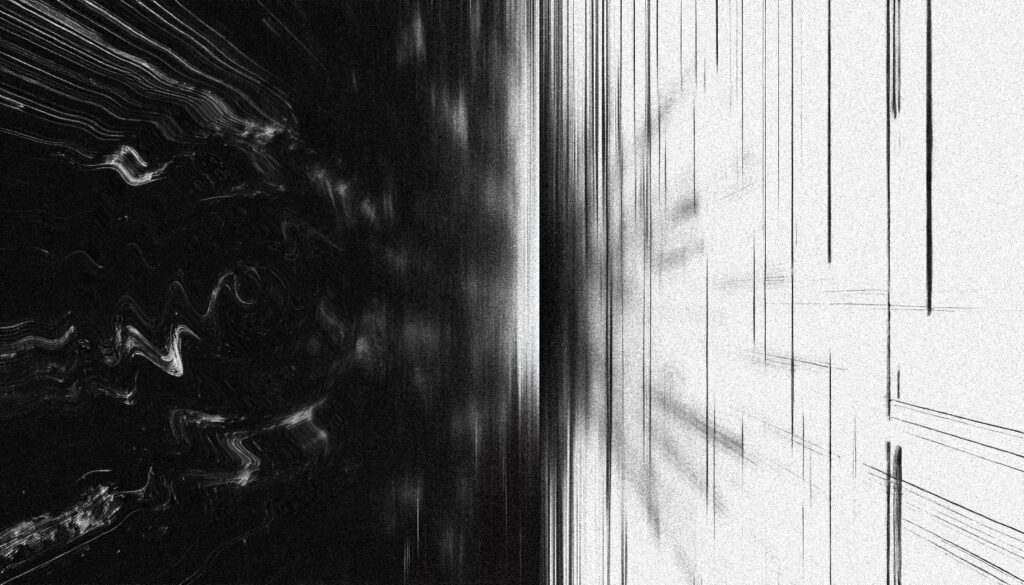
A Journey Through Light and Darkness
Adapting The Last Observer from prose to screenplay was more than just a creative challenge—it was an exploration of profound existential themes. The story follows a lone traveller on a journey to the end of time, venturing into the depths of a supermassive black hole in search of ultimate understanding.
Through the adaptation process, the story expanded into a 14-page screenplay, envisioned as a 14-minute short film, blending science fiction with introspection. This transition from page to screen allowed for a visually and sonically immersive experience, using cinematic techniques to heighten the core philosophical questions of the narrative.
The Story: A Voyage to the End of Time
At its core, The Last Observer is a cosmic exploration of the unknown—a solitary voyage that mirrors our deepest fears and desires. The Observer embarks on a journey beyond the event horizon, where time and space distort, leading him to confront existential questions about mortality, identity, and the nature of existence itself.
The screenplay blends hard science fiction with philosophical introspection, exploring the tension between human curiosity and cosmic inevitability. As the Observer approaches the black hole’s singularity, the story raises questions not just about the universe but about what it means to truly “see” and understand reality.
From Prose to Screenplay: A New Perspective
Adapting the original prose involved expanding the story’s structure while maintaining its contemplative essence. Two significant additions helped frame the screenplay’s themes:
- The Prologue and Epilogue: These bookend the film with the observer effect—suggesting that observation itself might alter reality, or perhaps, merely reveal it. This cyclical structure reinforces the theme that endings and beginnings are intertwined.
- Symbolism and Duality: The screenplay embraces contrasts—light and dark, chaos and order, life and death, silence and sound. Each element was carefully crafted to mirror the Observer’s internal and external journey.
Carl Jung’s quote, “How can I be substantial if I do not cast a shadow?” also plays a key role in shaping the narrative, reflecting the need to confront the unknown aspects of ourselves to become whole.
Crafting the Cinematic Vision





To visually represent the story’s core themes, the screenplay takes inspiration from the stark, grainy black-and-white aesthetic of Darren Aronofsky’s Pi, creating a meditative, dreamlike atmosphere. This contrast enhances the cosmic isolation of the Observer and emphasises the vastness of the void.
Key Visual Elements:
- Selective Colorisation:
- The event horizon glows faintly, symbolising memory and transcendence breaking through the darkness.
- Flashbacks and visions feature muted hues, reflecting fragmented recollections.
- The Observer’s final step into the unknown bursts into full colour, signifying rebirth and unity.
- Grain and Distortion:
- Subtle distortions and visual flickers symbolise the fragility of perception.
- Cosmic grain represents the noise of the universe, reinforcing the theme of observation.
- Sound Design:
- A low, eerie hum—reminiscent of NASA’s black hole sonifications—creates an immersive, unsettling auditory landscape.
- Silence punctuates moments of reflection and transformation.

Depression and the Call of the Void
One of the underlying emotional currents in The Last Observer is the exploration of depression and the concept of the “call of the void.” The Observer’s journey is not just a physical one but a reflection of the internal struggle many face when confronted with darkness—both literal and metaphorical.
The black hole, an ever-present force pulling at the Observer, serves as a powerful metaphor for the allure of oblivion. It represents the temptation of surrender, the weight of isolation, and the search for meaning in an indifferent universe. The interplay of light and darkness throughout the screenplay visually echoes the internal conflict of depression—where hope and despair coexist, and the journey to acceptance requires confronting the void rather than escaping it.
By positioning the Observer’s longing for “her” as a central motivator, the story humanises the cosmic scale of loneliness and existential reflection. The subtle cues—his lingering gaze, moments of hesitation, and ultimate decision to embrace the unknown—mirror the path toward healing, where light is found not in avoiding darkness but in understanding its place within the whole.
Themes of Death and Rebirth
Beneath its sci-fi exterior, The Last Observer reflects the universal experience of facing the unknown—mirroring the process of death and rebirth. The story explores both resistance and acceptance, echoing the duality of human experience when confronting the inevitable.
The prologue’s intense, chaotic imagery—the cosmic bursts of radiation, collapsing stars, and relentless hum—evokes the defiance and struggle captured in Dylan Thomas’ famous plea, Do not go gentle into that good night. It portrays the Observer’s initial resistance, his refusal to surrender to the vast unknown. However, as the narrative unfolds, a shift takes place. The meditative stillness that follows presents an introspective alternative, suggesting that true understanding may come not through struggle alone, but through acceptance.
Through its recurring motif of return, the story subtly asks: Is existence a forward march or a cyclical journey to an ultimate truth? In embracing both struggle and surrender, the Observer’s journey becomes a reflection of life’s final threshold—where resistance and acceptance coexist, each necessary in the path toward transcendence.
Soundtrack Inspirations
The auditory experience of The Last Observer is just as vital as the visuals, with potential soundtracks including:
- NASA’s Black Hole Sonification: An unsettling, howling sound that evokes the vast, incomprehensible nature of space, reinforcing the Observer’s existential solitude.
- Supermassive | Dark Ambient Noise Space Music: A deep, resonant soundscape mirroring the screenplay’s themes of duality and reflection.
- Dark Ambient Lo-Fi Music | Supermassive Black Hole Edition: A haunting backdrop that conveys isolation and the profound stillness of deep space.
The Observer and Narrator as One: The Observer Effect and Internal Dialogue
A crucial aspect of The Last Observer is the subtle implication that the Observer and the Narrator may, in fact, be the same entity viewed from different vantage points. This interplay reflects the observer effect—the philosophical and quantum idea that observation itself alters reality. In the screenplay, the Observer stands at the precipice of existence, witnessing the fading universe while simultaneously being a part of it.
This duality invites questions: Is the narration an external omniscient voice, or is it the Observer’s inner dialogue—his final reflections as he approaches the passage of death? The film leaves this open to interpretation, allowing the audience to consider whether the Observer’s journey is one of self-discovery or a final reconciliation with his existence.
By intertwining these perspectives, the screenplay subtly suggests that observation is not passive; it shapes reality. The final moments, where the Observer’s reflection distorts and merges with distant faces, reinforce the idea that identity itself is fluid—perhaps he was never alone, but always part of a greater whole.
A Meditation on the Infinite
In the end, The Last Observer invites viewers to reflect on their own place within the cosmos. It is a story that asks us to embrace both the light and the dark, to find meaning in observation, and to accept the unknown with quiet introspection rather than fear.
The screenplay adaptation elevates this journey, transforming it into an immersive cinematic experience that is both intimate and universal.
For an in-depth look at the scientific and philosophical ideas that inspired The Last Observer, check out Orbiting a Black Hole Until the End of the Universe: Science and Philosophy


Leave a Reply