

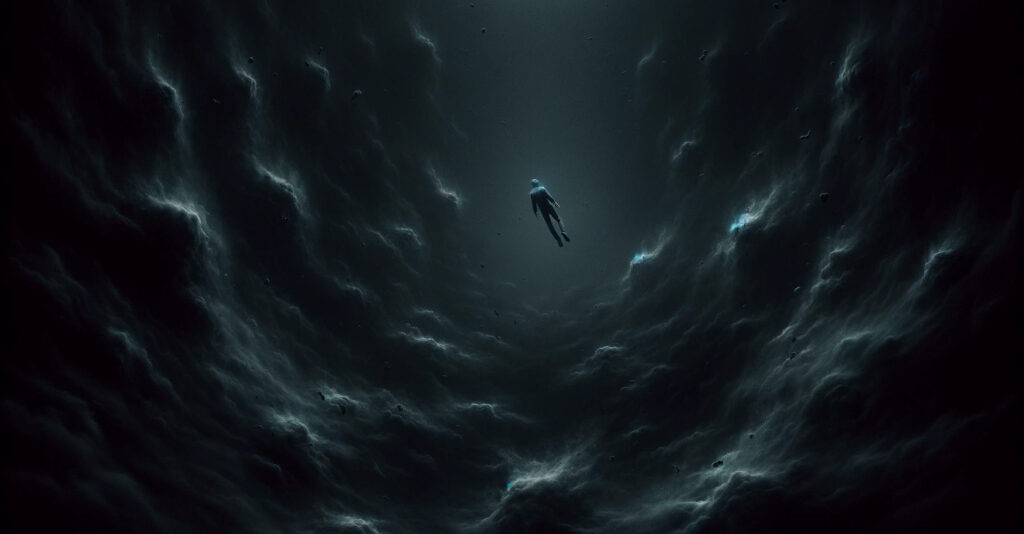
The concept of a human surviving until the end of the universe by orbiting a black hole is a fascinating blend of scientific possibility and philosophical inquiry. In the short story The Last Observer, the protagonist embarks on such a journey, experiencing the inexorable pull of a supermassive black hole like Sagittarius A* at the heart of the Milky Way. But what would it actually take to survive such a scenario? And what insights might it offer into the nature of existence?
The Science: Time Dilation Near a Black Hole
Gravitational Time Dilation
Einstein’s theory of general relativity tells us that time is affected by gravity. The closer you get to a massive gravitational source, the slower time passes relative to an observer farther away. This effect is described by the time dilation formula:
Where:
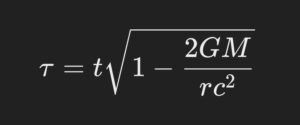
- τ = proper time experienced by the orbiting astronaut
- t = time experienced by a distant observer
- G = gravitational constant
- M = mass of the black hole
- r = orbital radius
- c = speed of light
For a supermassive black hole like Sagittarius A* (with a mass of about 4 million solar masses), time dilation could allow an astronaut to experience mere years while billions of years pass in the external universe.
Choosing the Right Orbit
For survival, an orbit just outside the event horizon (the point of no return) but within the innermost stable circular orbit (ISCO) is crucial. At this distance:
- Time slows dramatically.
- The gravitational pull is immense but survivable.
- Radiation from the accretion disk must be avoided.
A spacecraft would need precision engineering to maintain such an orbit, with continuous adjustments to counteract frame-dragging effects from a spinning black hole.
Challenges of Survival
- Radiation Exposure: Even if Sagittarius A* is relatively quiescent, accretion disks and cosmic rays pose significant threats.
- Energy Sources: Once the stars fade, finding sustainable power—possibly from Hawking radiation—becomes a key challenge.
- Psychological Strain: The isolation of orbiting an event horizon for trillions of years could take an immense psychological toll.
Consciousness vs. Space-Time
The prospect of a human consciousness surviving past the evaporation of a black hole raises profound philosophical questions. If such endurance is possible, it challenges our perception of space and time as fundamental constants. Einstein once described time as a “stubbornly persistent illusion,” and orbiting a black hole might reveal it as an emergent property rather than an absolute reality. Could consciousness exist beyond the known limits of physics, untethered from the constraints of entropy and decay? If an observer experiences only a few subjective years while witnessing the entire universe’s lifespan, does this imply that reality is shaped more by the observer than by the physical laws themselves? In such a scenario, the survival of consciousness could suggest that space-time is a framework of perception—flexible, subjective, and potentially transcended by the mind itself.
Hypothetical Experience Over Time
Early Years
- Familiar stars are visible, but they begin to drift away.
- Communication with distant space probes continues but grows delayed and fragmented.
Mid-Life (Trillions of Years)
- The universe becomes increasingly dark.
- Hawking radiation intensifies as the black hole shrinks.
- Loneliness becomes the predominant challenge.
Final Moments (10⁶⁷ YEARS*)
- The black hole evaporates in a burst of radiation.
- The astronaut, if surviving, faces an empty, cold universe devoid of energy.
*1067=10,000,000,000,000,000,000,000,000,000,000,000,000,000,000,000,000,000,000,000,000,000,000
For context:
- The estimated age of the universe is around 1010 years (~13.8 billion years),
- The number of atoms in the observable universe is estimated to be around 1080
Further Exploration
To better grasp the sheer magnitude of a black hole’s lifespan and the profound implications of cosmic time, consider the following:
- Tim Urban’s tweet offers an entertaining yet mind-blowing analogy: if you had an hourglass with a grain of sand for every particle in the universe, and one grain fell every
oneten billion years, you’d still be less than 1% through the black hole’s life.
- Timelapse of the Future: A Journey to the End of Time provides a stunning visual experience of the far future, depicting how the universe evolves over unimaginable timescales.
Both resources serve as a humbling reminder of our place in the cosmos and the vastness of time we’re attempting to comprehend.
Conclusion: The Ultimate Vigil
Orbiting a black hole until its eventual evaporation is a concept that blends the known limits of physics with speculative existential musings. Science tells us that it may be possible to stretch time to near infinity, but the cost is unimaginable isolation. Philosophically, it raises deep questions about the meaning of observation, existence, and whether survival is truly worth it when faced with the inevitable heat death of the universe.
Perhaps, in the end, the black hole offers a final lesson: that existence itself is a cycle, and the darkness is not an end, but a transformation waiting beyond the horizon.


Leave a Reply