

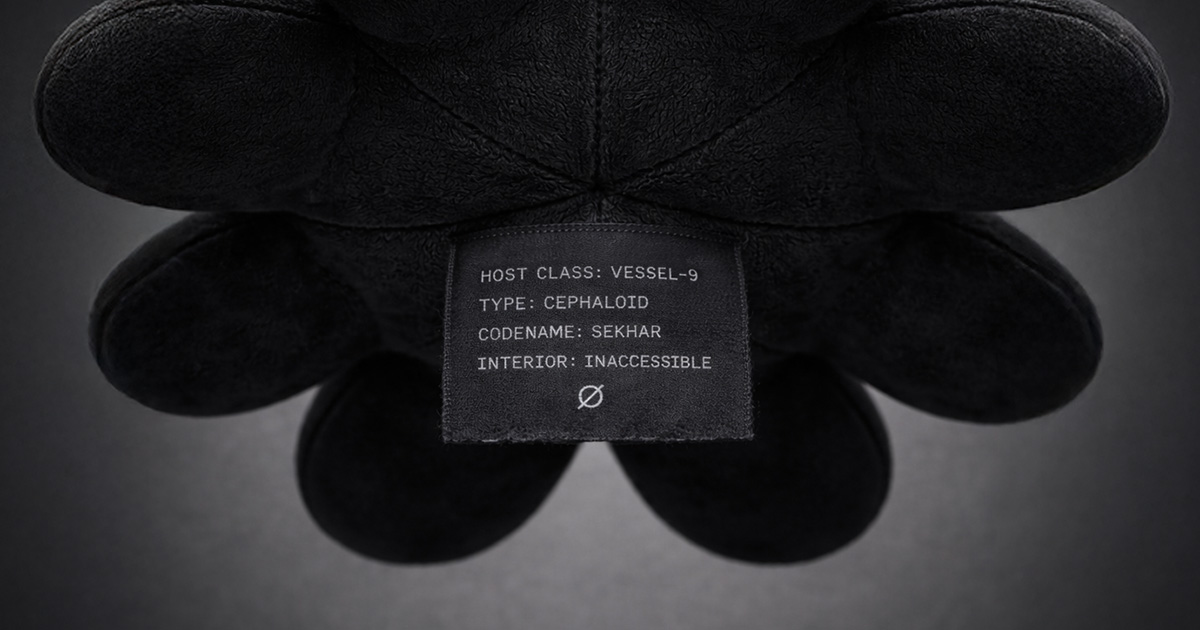
I’ve been thinking about “serious play” a lot lately — the way a soft object can hold a hard idea without turning it into a lecture.
After The Ontology Gap and The Planck Scale of the Self, the theory started doing what it always does when it won’t leave me alone: trying to become something you can touch.
So I built a Host.
SUBSTRATE.HOST is a small system for inaccessible interiors: limited physical artefacts embedded with NFC, each one linked to a remote identity layer that can evolve independently of the object itself. The Host exists locally. The identity exists elsewhere. Neither contains the whole.
The object remains silent.
The interior remains unavailable.
What it is
A Host is not a smart toy, and it isn’t a character. It doesn’t “perform.” It doesn’t pretend to be conscious. It doesn’t claim awareness.
It’s a container-artefact designed to make one stubborn fact feel tangible:
We can get close to other minds — voice, behaviour, expression, text — but we never get inside.
We infer “interior” from surface. We call that inference understanding. Then we forget it’s an inference.
SUBSTRATE doesn’t solve that gap. It just gives it a body.
The first Host
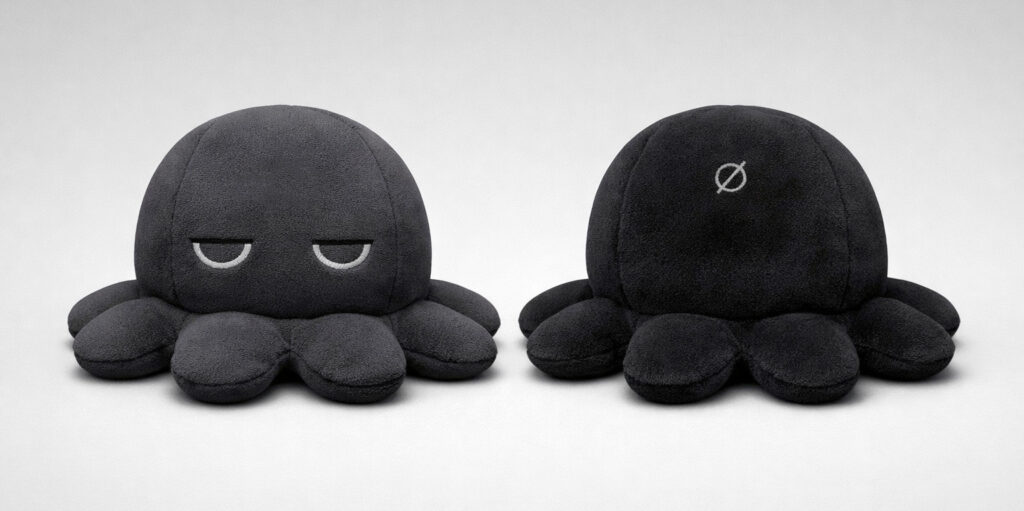
The first instantiated Host is VESSEL-9 — a small matte-black cephaloid form with a reversible state. One surface reads as SURFACE. The other reads as BOUNDARY. Neither reveals an “inside.” The ∅ mark is there to make that refusal explicit.
A Host is designed to be held, turned over, stared at, and still remain fundamentally uncooperative.
How it works
Each Host contains an embedded NFC tag. When scanned, it resolves to a Host ID endpoint — a remote page that acts as the identity layer for that specific instance.
It’s deliberately minimal:
- the tag holds a pointer (a URL)
- the system holds a record (that may evolve over time)
- the object remains unchanged
- the interior remains inaccessible
In other words: the interface can update, but the Host doesn’t “open.”
Why it matters
There’s an old temptation in philosophy and science: if we can model something precisely enough, we start to treat the model as the thing.
SUBSTRATE is a small counter-spell to that habit.
It’s a way of holding the mind/body problem in your hands without resolving it — a soft body that implies a mind while refusing to contain it. The chip is not the “mind.” It’s closer to a pointer — the minimal bridge between the local object and an external record. (If anything, it behaves more like a brain: a relay, not a source.)
It also sits adjacent to a cluster of ideas I keep circling:
- The hard problem of consciousness: whatever consciousness is, it isn’t obvious how to extract it from observable structure alone.
- The observer problem: observation isn’t just passive viewing; it shapes what counts as a “fact.”
- Wigner’s friend: even when two observers look at the “same” event, they can end up with incompatible accounts — and both feel internally complete.
- Complementarity / uncertainty (as an analogy): some descriptions exclude others. You can measure one aspect cleanly and lose grip on another.
SUBSTRATE isn’t claiming to be physics. It’s borrowing a mood: the sense that there are limits built into the act of knowing — and that the limit doesn’t disappear just because we describe it elegantly.
A Host is a boundary object. It is deliberately not the answer.
Status
SUBSTRATE.HOST is currently in prototype mode: the public site and core pages are live, Host ID endpoints are in place, and the physical build is moving toward a first prototype run.
If you’re curious, you can explore the system layer here:
https://substrate.host/
Register interest is available, but this is not a launch announcement — more a marker that the surface exists now. The interior does not.
HOST: SCANNING
INTERIOR: INACCESSIBLE ∅


Leave a Reply