

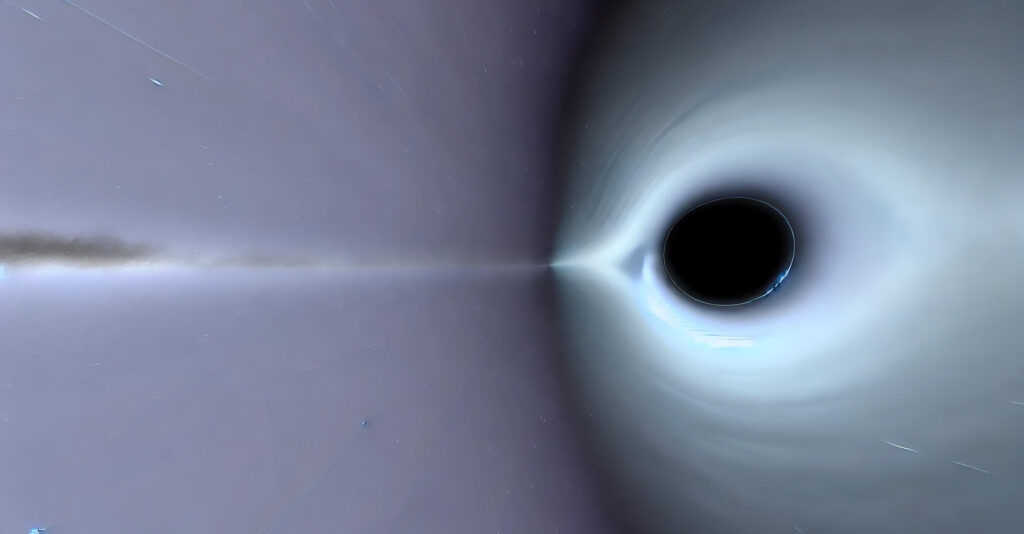
So, you’ve approached the event horizon and feel its effects—the pull of gravity, the slowing of time, the distorted view of the universe behind you. Now comes the leap into the unknown: crossing the event horizon. This boundary, beyond which even light cannot escape, is often referred to as the “point of no return.” What awaits beyond it, however, remains a mystery filled with equal parts science, speculation, and imagination.
A Sense of Weightlessness and Isolation
As you pass the event horizon, something paradoxical might occur: the gravitational pull that was pulling you forward might now feel like it has vanished. According to Einstein’s theory of relativity, once you’re inside the event horizon, the black hole’s gravity becomes part of your “inertial frame”—meaning you wouldn’t feel the pull as we normally experience gravity. You would feel strangely weightless, but in a way that might leave you with an overwhelming sense of isolation, as though you are adrift in a limitless void.
In Interstellar, Cooper’s character enters a wormhole and experiences a surreal sense of detachment from reality—a sensation that parallels the disorienting calm one might feel upon crossing the event horizon. This feeling of drifting into the cosmic unknown also captures the isolation and wonder of Solaris, where characters face their deepest fears and desires in an alien realm.
The View from Within: Watching the Universe Race By
Once inside, the experience would become even stranger. To an outside observer, you would have seemed to slow down infinitely as you approached, fading away to nothing. However, from your perspective, the outside universe would appear to speed up dramatically as you crossed the threshold, galaxies and stars racing by as if time itself were being fast-forwarded. You might even catch glimpses of the far future, watching stars die and galaxies disappear in seconds.
The concept of time acceleration inside a black hole is similar to the relativity effects in Poul Anderson’s Tau Zero, where characters traveling near light speed watch the universe age rapidly. In black holes, this distortion of time reveals the universe as an accelerating, chaotic spectacle—a glimpse into the lifespan of the cosmos in fast-forward.
Falling into Darkness: The Last Light
As you plunge deeper, light from outside the event horizon becomes redshifted beyond visibility, effectively leaving you in complete darkness. It’s as if the black hole is closing the universe off from view, plunging you into an endless void where sight, time, and space as you know it no longer apply.
This descent into darkness recalls the psychological effects portrayed in Event Horizon, where a spaceship’s crew crosses into an unknown dimension and loses contact with reality. Inside the event horizon, you would feel similarly severed from everything familiar, alone in a boundless, timeless expanse.
What Happens to Your Perception of Time?
Crossing the event horizon means entering a realm where time no longer has a clear direction. In theory, gravity is so intense within a black hole that time becomes tangled with space, making it impossible to determine which way time is flowing. For you, time may stretch out indefinitely, or it may collapse in an instant.
In Arthur C. Clarke’s The Last Theorem, characters ponder the extreme time dilation effects surrounding black holes and what they mean for existence. Similarly, in Contact, the idea of experiencing non-linear time creates a sense of wonder, as characters struggle to comprehend a new reality. Here, you might find yourself adrift in a state that blurs moments, memories, and future possibilities into an endless present.
The Philosophical Question of Consciousness
If time loses meaning inside a black hole, what happens to consciousness itself? Does your mind adapt to the warped time? Could you feel as if you’re suspended in an endless now, trapped in a state between moments, a thought stretched across eternity? This question taps into deep existential and philosophical territory, where science and metaphysics collide.
Stanislaw Lem’s Solaris explores this concept by placing characters in an environment that challenges their understanding of self and reality, hinting that our consciousness is shaped by our perception of time and space. Inside the event horizon, these boundaries dissolve, and with them, perhaps, a piece of what it means to be human.
Is There a Way Out? Wormholes and White Holes
Theoretically, passing through the event horizon could mean reaching the singularity—a point of infinite density and zero volume at the black hole’s core where the laws of physics as we know them break down. But some theories suggest there might be something else lurking inside a black hole: wormholes or even “white holes”—the hypothetical opposite of black holes, which expel matter instead of absorbing it.
The concept of wormholes has been explored in Interstellar, where the black hole Gargantua might connect to distant regions of space or time. In Carl Sagan’s Contact, wormholes serve as a gateway to other worlds, opening doors to unimaginable possibilities. Within a black hole, it’s possible that such a phenomenon could exist, offering a passageway to another universe, a distant part of this one, or even an escape route out of the black hole itself.
The “Veil” of Reality: Beyond Our Understanding
Perhaps the strangest possibility of all is that a black hole might act as a kind of cosmic veil—a boundary not just in space, but in reality itself. Crossing the event horizon could mean venturing beyond the limits of the observable universe and into a realm beyond our comprehension. Inside, our understanding of matter, energy, and consciousness could completely unravel, as though the black hole is guarding a fundamental truth about the universe that remains hidden from us.
In sci-fi works like Solaris and Event Horizon, characters encounter forces and realms that defy human logic, suggesting that some mysteries are meant to remain unsolved. The event horizon, in this sense, may not be just a physical boundary, but a metaphysical one, hiding secrets that transcend our universe’s rules and limitations.
Further Reading and Viewing
If you’re as fascinated by the mysteries of black holes as we are, here are some sci-fi books and movies that explore the psychological and physical implications of crossing the event horizon:
- Solaris by Stanislaw Lem and its film adaptations (1972, 2002) – A tale of isolation and altered perceptions in deep space.
- The Last Theorem by Arthur C. Clarke and Frederik Pohl – Examines extreme time dilation, cosmic boundaries, and survival.
- The Black Hole (1979) – A Disney film exploring a journey across the event horizon.
- Blindsight by Peter Watts – Explores alien life and altered consciousness, echoing themes of crossing into the unknown.
- Hyperspace by Michio Kaku – A nonfiction book introducing concepts of higher dimensions and wormholes, speculating on what may lie beyond a black hole’s event horizon.
Crossing the event horizon is a journey into the unknown, a step into a universe where time, space, and consciousness lose their familiar forms. What lies beyond remains one of science’s greatest mysteries—and one of the most profound questions in science fiction.
In the next post, we’ll dive deeper into the heart of the black hole itself: the singularity and theories about what it might mean for matter, reality, and perhaps even the fabric of the universe itself.
Continue to next post >>


Leave a Reply