

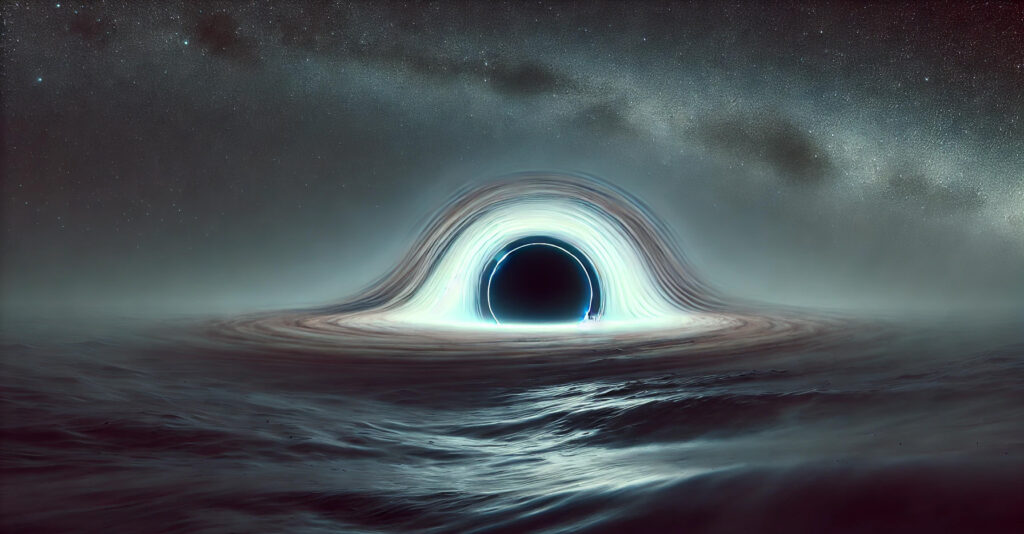
The event horizon—a place as mysterious as it is foreboding. This boundary of a black hole represents the point beyond which nothing, not even light, can escape. But what would actually happen if you were to approach it? Let’s take a journey to the edge of a black hole to explore the physics, sensations, and profound mysteries waiting at the event horizon.
Time Dilation: Where Time Slows to a Crawl
As seen in Interstellar and explored in Poul Anderson’s Tau Zero, time dilation near a black hole becomes extreme, and even existentially disorienting. To you, time would feel normal, yet for an outside observer, your approach would appear to slow down infinitely, eventually coming to a near standstill as you reach the horizon. From your own perspective, you might witness the universe speeding up, a chaotic, accelerated display of galaxies, stars, and cosmic events flashing before your eyes.
Imagine watching the rise and fall of entire civilisations in seconds, stars flickering in and out of existence like embers in a fire, as depicted in Clarke’s The Last Theorem. The overwhelming passage of time might feel like a psychological assault, making you question the nature of reality itself.
The Visual Effects: A Cosmic Hall of Mirrors
Gravitational lensing, vividly imagined in Interstellar and The Black Hole, would create surreal, distorted views of the universe, bending light around the event horizon. This “cosmic hall of mirrors” would stretch and magnify light from distant stars, warping the space around you into impossible shapes. The closer you get, the more redshifted everything becomes, as light waves stretch beyond visibility, leaving you enveloped in dim, faded darkness.
As in Event Horizon, the effect might feel almost haunting, as though the black hole is not just bending light but bending reality itself. Gravitational lensing would cast the universe into a ring of bright, distorted arcs, a last glimpse of everything you’ve known, frozen in time.
Spaghettification: The Final Stretch
In smaller black holes, tidal forces near the event horizon are so intense that they stretch any approaching matter—including you. This process, darkly named spaghettification, would pull you apart atom by atom. Larger black holes, however, exhibit gentler gradients at their horizons, allowing a person to approach without experiencing immediate stretching. In these larger black holes, you might cross the horizon almost peacefully, a brief lull before facing the unknown.
This stretching force, as hinted in Solaris, could trigger strange visions and experiences, possibly pulling your consciousness in ways that blur memory and time, making it difficult to discern your own thoughts from echoes of a broader cosmic awareness.
Psychological and Existential Effects: Facing the Unknown
Stories like Contact and Solaris capture the psychological weight of approaching the incomprehensible. The boundary between “you” and the universe begins to feel fluid, as if time, space, and identity are losing shape. You might feel an overwhelming sense of isolation, drifting away from everything you know, while also sensing an eerie connection to the black hole—a vast consciousness on the edge of existence.
The event horizon is not only a physical limit but a psychological one, presenting you with the ultimate existential mystery. Does your consciousness stretch along with your body, lingering at the edge of space-time? Or does it shift into a timeless void, unmoored from all you once knew?
For the Observer: A Final Farewell
In Interstellar and Event Horizon, black holes are not merely physical objects but entities of cosmic mystery. To an outside observer, your journey would appear slow and haunting. They would watch you gradually fade, each heartbeat stretching longer, each breath separated by eons, as if you were slipping into an eternal pause. Your light, dimming with extreme redshift, would eventually vanish as the black hole consumed even your image.
This would be your last transmission to the outside world—a frozen, ghostly echo left on the edge of the universe. In this way, the event horizon serves as a cosmic boundary that both separates and connects, a point where observation and experience diverge eternally.
A Prelude to the Unknown
Approaching the event horizon offers a glimpse of the universe at its most extreme, a point where physics, reality, and consciousness begin to unravel. As captured in fiction from Tau Zero to The Three-Body Problem, the boundary of a black hole is a gateway—a threshold into something beyond our understanding, something that tantalises and terrifies.
In the next post, we’ll take things a step further: what happens when you cross the event horizon? What lies on the other side of this point of no return, and what does it mean for those who venture beyond?
Further Reading and Viewing:
Contact (1997) – Directed by Robert Zemeckis
Tau Zero by Poul Anderson – A novel about relativistic travel and the effects of time dilation.
The Three-Body Problem by Liu Cixin – A sci-fi novel that explores cosmic mysteries and advanced physics.
Interstellar (2014) – Directed by Christopher Nolan, with a focus on the journey toward and effects of a black hole.
The Cosmic Code by Heinz Pagels – A nonfiction exploration of relativity and cosmic structure, exploring the foundations of space-time and event horizons.
Continue to next post >>


Leave a Reply