

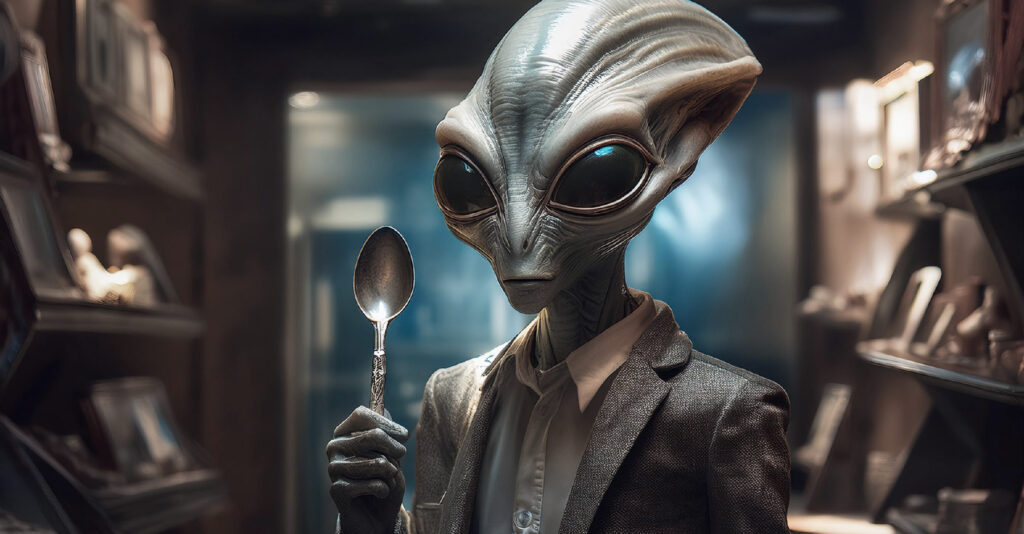
if (life.isOrdinary): archive(love, memory, small_moments);The museum was quiet, save for the soft hum of distant ventilation, whispering through the hallways like a memory nearly forgotten. The curator, tall and thin, glided between the displays, hands folded behind their back, eyes lingering on each glass case. Here, under the muted glow of artificial stars, the artefacts of a lost world rested in silence.
They stopped before one of the smaller cases, barely large enough to hold its contents. A single, frayed shoelace. The curator leaned in, their breath fogging the glass for just a moment before clearing, revealing the delicate fibers twisting together, threadbare and faded.
“Once, a person tied this,” they murmured. “Every day, perhaps, for years. Hands, long gone, performed the ritual—loop, knot, pull—without a second thought.”
The visitor beside them tilted their head, antennae twitching in quiet contemplation. “Was it important?”
The curator smiled, but it was a small, wistful thing. “No, not in the way we often think. This shoelace never saw war, nor wrapped itself around the foot of a great thinker. It didn’t belong to anyone history would care to remember. But it belonged to someone who lived.”
The visitor shifted, their gaze turning from the curator to the shoelace. “Lived how?”
“Ah.” The curator’s eyes softened, as if they could see past the glass, past time itself, and into the long-forgotten mornings of another era. “They lived like we all did once—moment by moment, small rituals folded into the hours. They walked down streets, their shoes tapping against the pavement, unaware that every step would someday fade into silence. They bent down to retie this lace when it came undone, perhaps frustrated, or maybe lost in a thought too distant to recall. They laughed at things we’ll never know, ate meals whose taste has long since vanished into the air, and held hands with people who no longer exist.”
The visitor’s antennae twitched again, thoughtful. “And this museum, it’s only filled with things like this?”
“Yes,” the curator said, looking around the room at the other cases. A broken pencil. A chipped mug. A pair of gloves, one missing a button. “Ordinary things. Forgotten things. But they were important, once. Not because they were special, but because they were… real. They were part of a world that no longer exists. These objects are like stars, flickering in the vast night of time, reminders that a life doesn’t need to be extraordinary to be remembered. Sometimes, the smallest moments are the ones that matter most.”
The visitor stared at the shoelace, their reflection in the glass casting faint, distorted shadows. They tried to imagine the hands that had tied it, the feet that had worn it, but it was hard to picture a world so distant, a life so small.
“But why keep them?” they asked, their voice soft as the hum of the ventilation. “If no one remembers… why keep them?”
The curator smiled again, this time a little wider, a little sadder. “Because they were loved. Once, for a time, someone loved these things. And that, I think, is reason enough.”
They stood there for a long moment, the visitor and the curator, two figures in the quiet museum, staring at a simple, forgotten shoelace that, somehow, in the vastness of eternity, had been remembered.
Soundtrack (made with Suno AI): Dust and Memory


Leave a Reply