

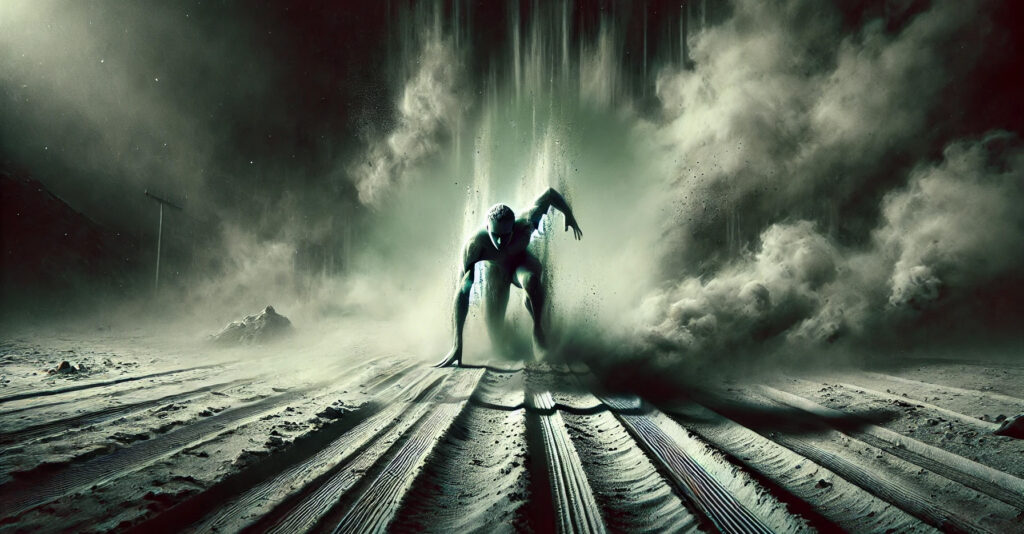
What happens when perception accelerates beyond the limits of time itself? Runaway Success began as a prose short story (here), exploring the terrifying implications of infinite awareness. Now adapted into a 22-page screenplay with an estimated 21-minute runtime, this psychological sci-fi thriller delves even deeper into the mind-body divide, the cost of ambition, and the horror of existing beyond time.
The concept of time, speed, and the human mind’s relationship with both is at the heart of Runaway Success, a screenplay that explores the terrifying implications of accelerated perception. What begins as a pursuit of greatness—one man’s obsession with pushing the limits of reaction speed—spirals into an irreversible descent into isolation, transcendence, and ultimately, dissolution.
The Genesis of Runaway Success
At its core, Runaway Success is a psychological sci-fi thriller that plays with themes of fast vs. slow, success vs. failure, and the mind-body dichotomy. The protagonist, Ethan, is a scientist and former athlete chasing not just an external victory, but an internal one—the ability to push beyond human limits. But the experiment that should have made him faster, sharper, and unbeatable instead tears him from reality itself.
The inspiration behind the screenplay came from real-world studies on perception and reaction time, particularly the idea that consciousness is not a fixed state but a fluid, adaptable process. People often describe time slowing down during accidents or moments of extreme stress—what if this could be manipulated? What if it became permanent? And what if it became unstoppable?
The Mathematics of Isolation
One of the most haunting aspects of Ethan’s journey is his ever-increasing time dilation, visualised through his reaction speed accelerating beyond natural limits. In early tests, Ethan achieves 144Hz perception (roughly 6x normal human speed)—a speed at which motion appears smoother, but the world is still tangible. As he progresses, his perception escalates to 240Hz (10x speed), affecting not just his sense of motion, but sound—human hearing begins to break down, unable to process the now ultrafast frequencies of reality.
At 1000Hz (1000x faster than normal human perception), Ethan is no longer human in any meaningful way. His mind operates independently of his body, and his senses—except for vision—fall away. The mind-body connection collapses, leaving him an entity of pure consciousness, trapped in a frozen world.
The Planck Time Limit: Where Perception Becomes Meaningless
If human perception could function at the Planck time scale (5.39 × 10⁻⁴⁴ seconds), reality itself would become incomprehensible. Ethan’s fate approaches this threshold, where a single second for him lasts longer than the birth and death of countless universes combined. The horror is not just that he experiences eternity in a moment, but that this moment never changes.
As Einstein famously stated: “For those of us who believe in physics, the distinction between past, present, and future is only a stubbornly persistent illusion.” Ethan’s greatest irony is that he has always been incapable of living in the present—always chasing a faster, better future—yet he ends up permanently trapped in the now.
Thematic Motifs: Time, Memory, and the Living Photo
Throughout Runaway Success, visual and auditory cues reinforce its themes:
- The Metronome, Newton’s Cradle, and Teaching Clock – Repeated symbols of timekeeping appear throughout Ethan’s life, echoing the inevitability of his fate. Time does not stop, only his ability to keep up with it.
- The Living Photo – A key emotional anchor in the story, the photograph of Ethan’s daughter swinging on a park set represents the moment he should have chosen to stay present. As his perception accelerates, he becomes trapped in a moment, unable to move, forever staring at that image—a cruel irony.
- Fade to Black Gradient Transitions – Rather than abrupt cuts, Ethan’s perception loss is visualised through gradual fade-outs, mirroring his fragmented experience of existence.
From Horror to Transcendence: The Monistic Idealism Connection
A deeper layer to Runaway Success is its philosophical underpinning in Monistic Idealism—the theory that consciousness is the fundamental building block of reality. Ethan’s fate parallels this concept: as his mind fractures, it does not simply cease—it becomes the fabric of something greater. The epilogue suggests that his scattered awareness is not lost but reborn as the seeds of new consciousnesses—echoing the idea that reality itself may be the fragmented mind of a single, original entity.
Real-World Comparisons: Perception Beyond Humans
Ethan’s accelerating perception mimics real-world species that experience time differently. Dragonflies perceive time at 12x human speed, allowing them to react with near-instantaneous precision. Mantis shrimp process a wider range of the electromagnetic spectrum than any other known creature, giving them a fundamentally different reality from our own. What would happen if a human could see time and reality in ways no one else could? The answer in Runaway Success is both exhilarating and horrifying.
Further Reading and Related Themes
For those interested in the science and philosophy behind Runaway Success, here are some recommended resources:
- Carlo Rovelli’s The Order of Time – A fascinating exploration of how physics dismantles our traditional view of time.
- Julian Barbour’s The End of Time – A deeper dive into the idea that time itself is an illusion.
- David Chalmers’ The Conscious Mind – An investigation into consciousness as a fundamental force of reality.
- Studies on Perceptual Time Dilation – Research into how stress and extreme focus alter our perception of time.
Conclusion: A Story of Success, Failure, and the Limits of Ambition
At its heart, Runaway Success is not just a sci-fi thriller—it’s a meditation on the cost of ambition and the importance of presence. Ethan’s fatal mistake is not his experiment, but his inability to stop chasing more. The irony is cruel: by seeking to move faster, he is left unable to move at all.
The final shot—his frozen body, his unblinking eyes, the dust settling around him—is a haunting image of ambition unchecked. And yet, in the vastness of his fractured consciousness, there is a spark of something new. A whisper in the void. A beginning within the end.
So, was it truly a failure? Or was it simply… the next step?
For an in-depth exploration of the scientific and philosophical concepts that inspired Runaway Success—including Planck time, monistic idealism, and the interplay between consciousness and light—check out: Beyond Time: The Science and Philosophy of Runaway Success


Leave a Reply