

while (time < entropy_max) {
    signal_strength -= noise_increase
    if (signal_strength <= noise_threshold) {
        broadcast = "last transmission"
        end_information()
    }
}
In a universe governed by entropy, everything trends toward disorder and decay. While energy is conserved, information—the patterns, structures, and order we rely on to understand the world—slowly unravels. In an era dominated by information technology and data, what would the ultimate end of information look like? Could there come a time when not only energy but the very structure of knowledge and data collapses into chaos?
This article explores the concept of entropy through the lens of information theory, weaving together the philosophical, technological, and cosmological implications of a future where data decays, knowledge disappears, and communication becomes impossible—the last broadcast in a universe losing its ability to store or transmit meaning.
Entropy and Information: A Parallel Decline
In physics, entropy is a measure of disorder in a system. Over time, closed systems move from states of order to disorder, and eventually, all systems trend toward maximum entropy—a state where energy is evenly spread, and no useful work can be done. In a similar way, information theory suggests that data, like energy, is subject to degradation.
Consider the vast digital infrastructure we rely on today: server farms, data centers, cloud storage. As data accumulates, it requires constant maintenance and energy to keep it intact and accessible. Information, without intervention, is prone to decay—files become corrupted, storage systems fail, and data becomes inaccessible. At the same time, as more and more information is created, noise begins to overwhelm signal—the meaningful data we want becomes buried beneath an avalanche of irrelevant or degraded information.
In the distant future, as entropy continues to increase in both the physical and informational realms, it’s possible that we may witness the collapse of meaningful data—the moment when the signal is lost, and all that remains is noise.
The Digital Age: Can Information Outrun Entropy?
The digital revolution has allowed us to store vast amounts of data, but it has also exposed us to new vulnerabilities. Hard drives fail, servers crash, and even our most robust data storage methods—like DNA data storage or quantum computing—are still subject to the laws of physics.
Our growing reliance on cloud-based storage means that much of the information we depend on is no longer physically within reach. If a system failure or catastrophic event were to occur on a global scale, we could face the rapid loss of access to decades’ worth of human knowledge. Could we reach a point where information, like energy, begins to leak away, lost in the growing chaos of a disordered system?
In this sense, entropy and information are on a collision course. Despite our efforts to organise and preserve data, the natural tendency toward disorder means that our digital infrastructures are constantly at risk of degradation. This poses the question: is there an end point, a moment when the last meaningful piece of data is transmitted, and all that remains is noise and silence?
Cosmic Entropy: The Heat Death of Information
The concept of heat death in cosmology predicts a distant future where the universe reaches maximum entropy. At this point, stars burn out, matter becomes scattered, and all processes that create order cease. But what happens to information in this scenario?
In the physical universe, entropy erases complexity. Stars, galaxies, and even black holes will eventually dissolve into a uniform soup of particles. But, as suggested by physicist John Wheeler’s famous phrase, “it from bit,” the very structure of reality is built from information. If the universe itself is informational at its core, then its decline into maximum entropy also implies the end of information.
The ultimate fate of information—whether it can be destroyed, preserved, or transformed—remains one of the deepest philosophical and scientific questions. In a universe ruled by entropy, even the most durable records of existence may eventually disappear, scattered into meaningless bits. This leads to a profound question: will the last broadcast in the universe be one of total silence?
The Last Broadcast: When Data Becomes Noise
In the realm of communication, entropy manifests as noise—interference that distorts or blocks the transmission of a signal. The more entropy increases, the more difficult it becomes to distinguish the signal from the noise. As systems age, errors accumulate, and noise begins to overtake the message.
This metaphor of signal vs. noise mirrors the cosmic battle between order and chaos. As time progresses, systems of communication—whether biological, digital, or cosmic—become increasingly prone to noise and distortion. Eventually, the signal fades altogether.
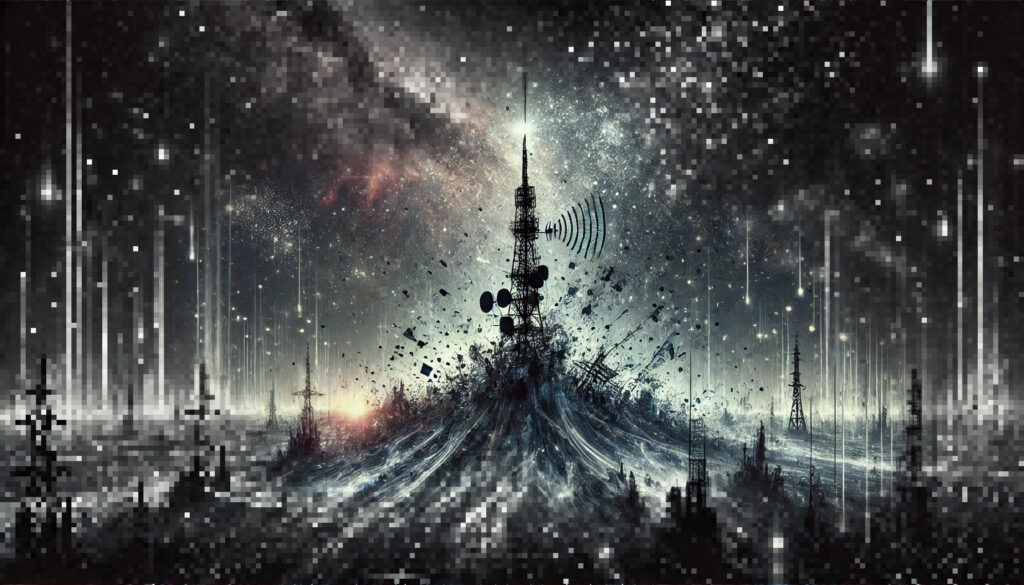
Could there come a time when, across the entire universe, all signals fade, and the only thing left is noise? In this vision, Entropy’s Last Broadcast is the final transmission before all meaning is lost. This isn’t just a metaphorical end—it could be the literal end of all communication, where no data, no information, and no message can survive. The last broadcast would be indistinguishable from the cosmic static of a universe in decay.
The End of Human Knowledge: When Information Decays
Closer to home, the loss of information and knowledge could have profound implications for humanity’s future. History is filled with examples of knowledge lost to time—entire civilisations whose records have been destroyed, forgotten, or corrupted. In a future where digital systems collapse, could we witness a second Dark Age? The end of physical books, the loss of digital archives, and the decay of knowledge could leave future generations with fragments of what once was—a universe devoid of the intellectual legacy we’ve built.
This possibility raises profound ethical questions: what should we do to preserve knowledge in the face of entropy? Will our greatest achievements be wiped out, or will there be a way to preserve meaningful information for future generations, even as systems degrade?
Humanity’s Last Stand: Fighting Entropy with Code?
There are efforts underway to combat entropy in the digital realm, from innovative data storage solutions to cutting-edge error-correction algorithms. Quantum computing, for example, holds the promise of revolutionising how we store and process information, making systems more resilient to noise and decay.
But the larger question remains: can we truly outrun entropy? Is there a point at which the complexity of our systems overwhelms our ability to maintain order? Can our efforts to preserve information withstand the slow, inevitable march of entropy in the long term?
In the end, Entropy’s Last Broadcast may not be a sudden collapse but a gradual, inevitable fading—where the signal weakens, the data fragments, and the meaning slowly dissolves. Whether we fight it or accept it, entropy’s influence over information is undeniable.
Conclusion: The Fading Signal of the Future
Entropy’s Last Broadcast is not just about the heat death of the universe or the collapse of stars. It’s about the slow decay of the structures that hold our knowledge, our communication, and our understanding of reality together. In a universe governed by entropy, the fight to preserve information is a race against time.
One day, the last meaningful signal may be transmitted, and all that remains will be noise—the final echo of a universe that once held structure, knowledge, and life. Whether through digital collapse, cosmic decay, or the natural end of the universe, the end of information is an inevitable outcome in a reality governed by entropy. The only question is: what will we do with the time we have left before the broadcast goes silent?


Leave a Reply