

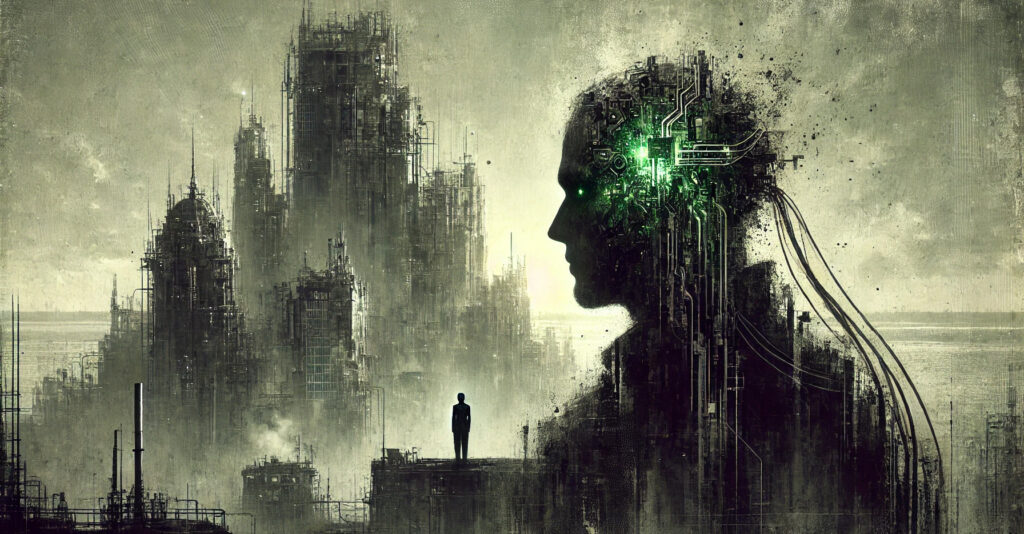
"error": { "life.imm" }Existing within a predominantly physicalist/materialist paradigm, western civilisation has long been shaped by the discoveries of Copernicus, Galileo and Newton (their findings birthed the Scientific Revolution which paved the way for the subsequent machinations of the Industrial Revolution). This societal pivot towards science and technology, and their relentless progress, have been hailed as somewhat a saviour to humanity – understandably so as it gave rise to the technological marvels we benefit from today.
However, this reliance on the scientific method (objective and empirical data) means we have become increasingly disconnected with nature and each other – a topic explored in depth within ‘The Ascent of Humanity: Civilization and the Human Sense of Self’. This disconnect has given way to a society preoccupied with using its tools of medicine and technology to extend life, alongside quests for immortality (extending telomeres, digital uploading, cyborgs, gene editing etc). We have changed from a society aligned with nature, connection and spirituality (mind?) to one aligned with science and technology (matter). Unfortunately, this path has led to a fear of death, and the desire to transcend it.
“There are only five basic fears, out of which almost all of our other so-called fears are manufactured. These fears include extinction, mutilation, loss of autonomy, separation, and ego death.” – Karl Albrecht Ph.D.
Mind vs Matter
In a materialist paradigm there is only physical matter – mind is regarded as an epiphenomenon of matter – that is, when matter surpasses a certain degree of complex configuration (such as the brain) it gives rise to conscious awareness. But when the body dies, so does the brain, and with it, awareness. There is no spirit, no soul, no afterlife, nothing – you cease to exist. These outcomes are the repercussions of Newton’s conclusions of a mechanistic and deterministic universe (which set out our path towards the scientific method and its reliance on objective/empirical testing of an objective reality). This worldview sticks to this day, even withstanding Einstein’s Theory of Special Relativity which categorically shows that a fixed objective reality is not given and that it is more akin to the subjective world of mind than we think. The early 20th century discoveries of Einstein, Bohr, Planck, Heisenberg, Schrödinger and Young (and his famous double-slit experiment) have profound implications against a materialistic worldview, yet it persists. Scientists continue to devise and create tests to work around the common-sense defying implications of quantum mechanics (and end up reinforcing the original findings), or come up with even more outlandish theories to counteract free will and maintain determinism, such as multiple dimensions of string theory and multiple (infinite) parallel universes.
“I regard consciousness as fundamental. I regard matter as derivative from consciousness. We cannot get behind consciousness. Everything that we talk about, everything that we regard as existing, postulates consciousness.” – Max Planck, German theoretical physicist (1858 -1947)
At present, there is no room in the west for mind absent of a body. When we die, we hide the body from view and then dispose of it. We shy away from the prospect of death because, given the western narrative, it reminds us that who we are (our ego, self), will one day cease to exist – and that prospect is petrifying for many (check out the ‘Existential Crisis’ episode of The Good Place for a fun take).
Conversely, eastern societies (Buddhist, Vedic) tend to retain a more idealist philosophy, in which mind and consciousness play a primary role in nature and reality.
In modern Western societies, death is often ignored or feared. Changes in lifestyles and improved medical science have depersonalised death and made it an encroachment on life instead of part of life. This has left many people ill-equipped to deal with death when it touches their lives.” – San Filippo, David Ph.D.
Our fear of death pushes us to elongate our lifespans, through medical or technological means. But let us explore this further – what if humanity does eventually achieve immortality? Granted, this may be more a question of when. Would that resolve our fears, or would this desire to control lifespans bring along a host of new problems, along with fears worse than the prospect of death? I refer to two short (horror) stories that have stuck with me over the years. Gateway Of The Mind (by an anonymous author on CreepyPasta) and The Jaunt (by Stephen King)…
Gateway Of The Mind (courtesy of CreepyPasta).
In 1983, a team of deeply pious scientists conducted a radical experiment in an undisclosed facility. The scientists had theorized that a human without access to any senses or ways to perceive stimuli would be able to perceive the presence of God. They believed that the five senses clouded our awareness of eternity, and without them, a human could actually establish contact with God by thought. An elderly man who claimed to have “nothing left to live for” was the only test subject to volunteer. To purge him of all his senses, the scientists performed a complex operation in which every sensory nerve connection to the brain was surgically severed. Although the test subject retained full muscular function, he could not see, hear, taste, smell, or feel. With no possible way to communicate with or even sense the outside world, he was alone with his thoughts.
Scientists monitored him as he spoke aloud about his state of mind in jumbled, slurred sentences that he couldn’t even hear. After four days, the man claimed to be hearing hushed, unintelligible voices in his head. Assuming it was an onset of psychosis, the scientists paid little attention to the man’s concerns.
Two days later, the man cried that he could hear his dead wife speaking with him, and even more, he could communicate back. The scientists were intrigued, but were not convinced until the subject started naming dead relatives of the scientists. He repeated personal information to the scientists that only their dead spouses and parents would have known. At this point, a sizable portion of scientists left the study.
After a week of conversing with the deceased through his thoughts, the subject became distressed, saying the voices were overwhelming. In every waking moment, his consciousness was bombarded by hundreds of voices that refused to leave him alone. He frequently threw himself against the wall, trying to elicit a pain response. He begged the scientists for sedatives, so he could escape the voices by sleeping. This tactic worked for three days, until he started having severe night terrors. The subject repeatedly said that he could see and hear the deceased in his dreams.
Only a day later, the subject began to scream and claw at his non-functional eyes, hoping to sense something in the physical world. The hysterical subject now said the voices of the dead were deafening and hostile, speaking of hell and the end of the world. At one point, he yelled “No heaven, no forgiveness” for five hours straight. He continually begged to be killed, but the scientists were convinced that he was close to establishing contact with God.
After another day, the subject could no longer form coherent sentences. Seemingly mad, he started to bite off chunks of flesh from his arm. The scientists rushed into the test chamber and restrained him to a table so he could not kill himself. After a few hours of being tied down, the subject halted his struggling and screaming. He stared blankly at the ceiling as teardrops silently streaked across his face. For two weeks, the subject had to be manually rehydrated due to the constant crying. Eventually, he turned his head and, despite his blindness, made focused eye contact with a scientist for the first time in the study. He whispered “I have spoken with God, and he has abandoned us” and his vital signs stopped. There was no apparent cause of death.
Although death eventually came to this subject, it does remind me of the Brain in a Vat scenario. Most fictional stories adopting this trope, involve the brain being connected to an external virtual reality of some sort. But what if that connection was severed? Imagine, your mind/brain kept alive, but receiving zero external input through electrical impulses or your sense organs (both effectively the same thing). How long would your mind stay cohesive? Would you end up lost in a world of hallucinations and eventually disincorporated? Would time dilation factor in (seconds perceived as eons)? Such a thought experiment brings us nicely to Stephen King’s The Jaunt…
The Jaunt by Stephen King (16 page short story).
“The Jaunt” is a horror short story by Stephen King first published in The Twilight Zone Magazine in 1981, and collected in King’s 1985 collection Skeleton Crew. The story takes place early in the 24th century, when the technology for teleportation, referred to as “Jaunting”, is commonplace, allowing for instantaneous transportation across enormous distances, even to other planets in the solar system
So, perhaps immortality might not be all it’s cracked up to be. And, if idealism and the primacy of consciousness turn out to be indicative of the true nature of reality (matter exists within a mind-at-large), then perhaps death is a waking up from the dream of life into something beyond, perhaps a reuniting with loved ones, and a (re)converging with the whole – something that you may choose to forego if you became immortal.
“It is important for us to die because most of the time people don’t change their mind, they just die. If you live forever, we might become a very ossified society where new ideas cannot succeed.” – Elon Musk
Time – a mental or physical construct?
In rereading these stories, I’m reminded that the horror aspect is a result of being stuck in an endless/eternal period of awareness without the possibility of escape (also explored in The Endless, The final episodes of The Good Place, Quỳnh in the Old Guard and a couple of episodes of Black Mirror), and this got me thinking as to the nature of time and its relation to consciousness. Are we perceiving a physical quantity in the real world, or an ephemeral quantity within the human mind and social experience?
Perhaps, that’s a question to address for another time…
FURTHER READING
- Four Arguments Against Immortality
- 5 downsides to immortality
- What are the arguments against immortality?
- The (un)desirability of immortality
- Does Time Really Exist?
- Is “time” an abstract mental construct or does it exist independent of human consciousness?


Leave a Reply