

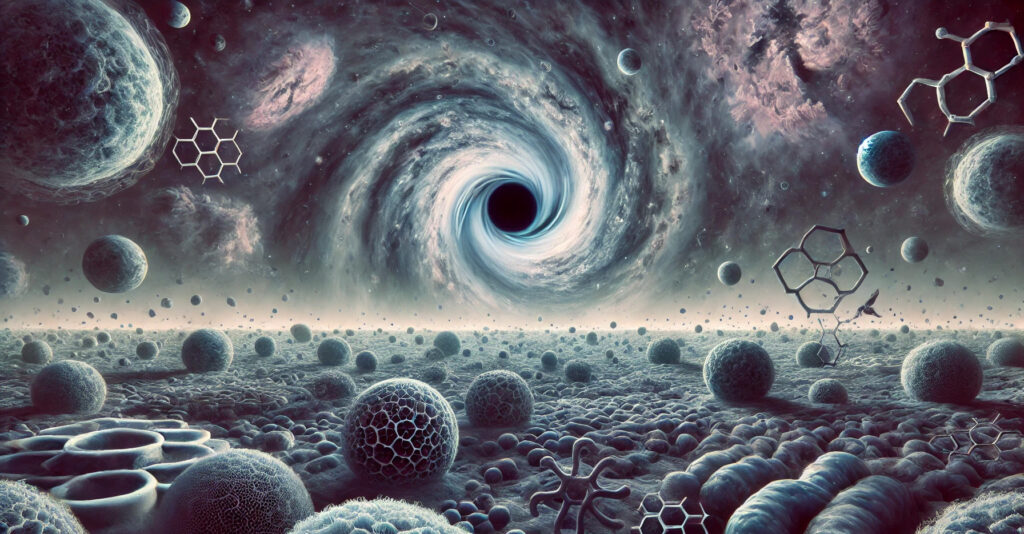
Black holes represent some of the universe’s greatest mysteries, but they also echo patterns found at smaller scales. This concept—“as above, so below”—suggests that the microcosmic mirrors the macrocosmic, and that the structures and forces we observe within the universe might be mirrored within ourselves and the natural world. From atomic structure to hurricanes, black holes may reflect phenomena we can see, touch, and understand. But what do these parallels suggest about our own reality? And could black holes be more connected to us than we realise?
The Atom and the Black Hole: A Structural Parallel
Just as black holes condense vast amounts of matter into an incredibly dense region, atomic nuclei pack nearly all of an atom’s mass into a tiny centre. Electrons orbiting an atom’s nucleus form a “cloud” similar in shape to the event horizon of a black hole, where all matter is pulled toward a central singularity. Just as light cannot escape a black hole’s pull, electrons are held in place by the nucleus’s gravity-like pull.
In The Cosmic Code by Heinz Pagels, parallels between atomic structure and cosmic phenomena are explored, questioning whether the universe is composed of endlessly repeating patterns at different scales. This structural mirroring between atoms and black holes implies that the universe may be fractal-like, each level of reality reflecting the larger whole.
Storms and Black Holes: The Eye of the Cosmos
At a more observable scale, black holes bear a surprising resemblance to hurricanes and tornadoes. Both black holes and cyclonic storms have “eyes”—calm centres surrounded by turbulent fields. In the same way that matter spirals into a black hole, air spirals into a hurricane or tornado, gathering speed and intensity as it nears the centre.
In The Windup Girl by Paolo Bacigalupi, the dynamics of hurricanes are vividly explored, highlighting the destructive but awe-inspiring nature of these powerful storms. The eye of a hurricane and the core of a black hole share a common structure, with turbulent outer edges and a silent centre, suggesting that spiral dynamics are universal forces that shape both our atmosphere and the vast reaches of space.
Galactic Filaments and Neural Networks: The Web of the Cosmos
When we look at large-scale maps of galaxies, clusters form massive filaments and structures that bear a striking resemblance to neural networks in the human brain. In both, structures are connected by filaments or “paths” that channel energy or information. This resemblance hints that the universe may be organised in ways we don’t yet fully understand—where consciousness, connection, and communication are fundamental components not only of life but of the cosmos itself.
This parallel is beautifully explored in Blindsight by Peter Watts, where alien life forms are revealed to communicate and exist in ways that mirror neural networks, suggesting that the universe’s fundamental structure may allow for consciousness and connection at grand scales. The “cosmic web” of galactic filaments may hint at an underlying intelligence in the universe, as though it, too, might possess a form of awareness.
Black Holes and Cell Death: The Cycle of Life and Decay
Black holes may also reflect the natural cycle of death and rebirth seen in cellular biology. In our own bodies, cells are programmed to self-destruct when they’re no longer needed—a process called apoptosis. This process allows for the recycling of materials, fueling growth and regeneration. Similarly, black holes absorb matter, pulling it into their cores, and possibly ejecting energy that feeds the surrounding galaxy.
In Diaspora by Greg Egan, the boundaries between life, death, and regeneration are explored, with characters existing as information patterns that evolve, adapt, and transform. Black holes, in this view, may be cosmic recyclers, consuming and redistributing matter to fuel new life, echoing cellular death and renewal.
The Fractal Universe: Patterns at Every Scale
One theory that ties together these parallels is the idea of a fractal universe—a universe where structures repeat at every scale, from the microscopic to the cosmic. Fractals are shapes that appear the same regardless of magnification, and this idea extends to black holes and natural phenomena. If our universe is fractal in nature, then black holes might just be the larger-scale versions of processes occurring all around and within us, embodying a universal law of structure and symmetry.
In Infinity by Michael Hanlon, fractals and cosmic patterns are examined as a way of understanding the “endlessness” of space and structure. This idea—that the universe is composed of self-similar structures—suggests that black holes could be part of an endless cosmic recursion, reflecting processes found in everything from our cells to the stars.
Black Holes as Gateways: The Veil Between Worlds
Finally, some philosophical interpretations suggest that black holes could represent a kind of “veil” between worlds—boundaries between different states of reality. Just as atoms hold subatomic particles within an unseen force, black holes could be gateways to different dimensions, as though they were membranes separating realities. This concept is explored in science fiction through the idea of black holes as portals, not only to other parts of the universe but to entirely new dimensions or forms of existence.
In Flatland by Edwin A. Abbott, we see an exploration of different dimensions and perspectives, revealing the limitations of human understanding in perceiving reality. In a similar way, black holes could be boundaries separating different “layers” of reality. For beings within our own universe, they’re cosmic endpoints, but beyond them may lie realities beyond our perception.
Further Reading and Viewing
For more on the parallels between black holes, nature, and consciousness, here are some books and films that explore these themes:
- The Cosmic Code by Heinz Pagels – A book exploring the parallels between atomic structures and cosmic phenomena, questioning reality’s endless patterns.
- The Windup Girl by Paolo Bacigalupi – Examines natural forces like hurricanes, whose structures mirror those of black holes.
- Diaspora by Greg Egan – A novel that tackles themes of life, death, and evolution on a cosmic scale, echoing black holes’ potential role in the cycle of creation.
- Flatland by Edwin A. Abbott – Though not explicitly about black holes, this novella delves into dimensional perspectives, suggesting that black holes might act as cosmic boundaries between realms.
The parallels between black holes and natural structures serve as reminders that, while black holes might seem foreign and distant, they may embody principles that are close to home. As we peer into the cosmos and encounter black holes, we may simply be discovering yet another manifestation of a universal order—a structure that connects galaxies and cells, neurons and galaxies, in a cosmic network woven from the same fundamental patterns.
From atomic nuclei to hurricane eyes, the world of the small mirrors the vastness of space. Perhaps black holes are a reminder that, in the grand scheme, everything is connected. The infinite and the infinitesimal may be one and the same—a reflection of a single, mysterious reality.


Leave a Reply