

input_human_idea = create_seed()
output_AI_art = AI_generate(input_human_idea)

if (AI_output == creative) {
    co_create = merge(human_input, output_AI_art)
}

display(co_create)
The rise of artificial intelligence (AI) has revolutionised many fields, but nowhere is its impact more controversial than in the world of creativity. Traditionally, art, music, writing, and other forms of creative expression have been seen as uniquely human endeavours, deeply tied to emotion, culture, and the personal experience. However, the advent of AI tools capable of generating art, music, and even literature challenges this assumption.
Are we approaching a future where machines will create as fluently as humans? And if so, how do we differentiate between human art and machine-generated creativity? This article explores the growing intersection of human and machine creativity, the philosophical and ethical implications, and what this fusion means for the future of art.
The Emergence of AI Creativity: A Brief History
AI has long been a tool for solving logical problems, but it has recently expanded into the realm of creative expression. Early AI-generated art emerged from programs designed to mimic human decision-making in structured environments. Over time, advancements in machine learning and neural networks have allowed AI to generate increasingly sophisticated works that blur the line between human and machine contributions.
From DeepDream’s surreal imagery to OpenAI’s GPT models generating poetry and stories, AI is pushing the boundaries of what we consider creative output. These systems are trained on massive datasets of human-created content—images, music, and text—which allows them to produce works that imitate human creativity with startling accuracy.
How AI Learns to Create: Machine Learning and Neural Networks
At the heart of AI’s creative abilities is the process of machine learning, where AI systems analyse vast amounts of data, recognising patterns and structures that enable them to generate new, original content. Neural networks—AI models inspired by the human brain—allow machines to make decisions and predictions based on this data, whether it’s generating a melody, composing a poem, or designing an image.
These AI models don’t create art in the way humans do; they don’t have emotions, intent, or personal experience. Instead, they replicate the structure and form of the data they’ve been trained on, mimicking the creative process. However, their output is often indistinguishable from human-created work. This raises the question: can we consider AI-generated works creative, or are they merely reflections of the data they were trained on?
The Human Touch: Where Does Emotion Fit In?
One of the core arguments against AI creativity is that machines lack emotion—a key ingredient in human art. Human creativity is often a reflection of personal experience, emotional depth, and the artist’s unique worldview. When humans create, they do so with intent, expressing ideas, feelings, and philosophies through their work. Machines, by contrast, lack intent and emotional understanding, and their creations are the result of algorithms, not personal expression.
Yet, AI is capable of evoking emotion in its audience. AI-generated art, music, and writing can still move people, stir emotions, and provoke thought. In some cases, AI-generated art has been sold at auction, exhibited in galleries, and praised for its beauty or ingenuity. This complicates the argument—if an audience reacts emotionally to a piece of AI-created work, does that not validate it as art?
Perhaps the deeper question is: does emotion in art reside in the creator or in the observer? If AI can produce work that resonates with human emotions, even without understanding those emotions itself, does that blur the line between what is “real” art and what is machine-generated mimicry?
Collaboration or Competition: Human and Machine Co-Creation
Rather than viewing AI as a competitor to human creativity, many artists see it as a powerful tool for collaboration. AI can assist artists in new ways, helping them explore different creative directions or overcome creative blocks. For example, visual artists might use AI to generate patterns or abstract designs that inspire new pieces, while musicians can employ AI to create unique soundscapes or rhythms.
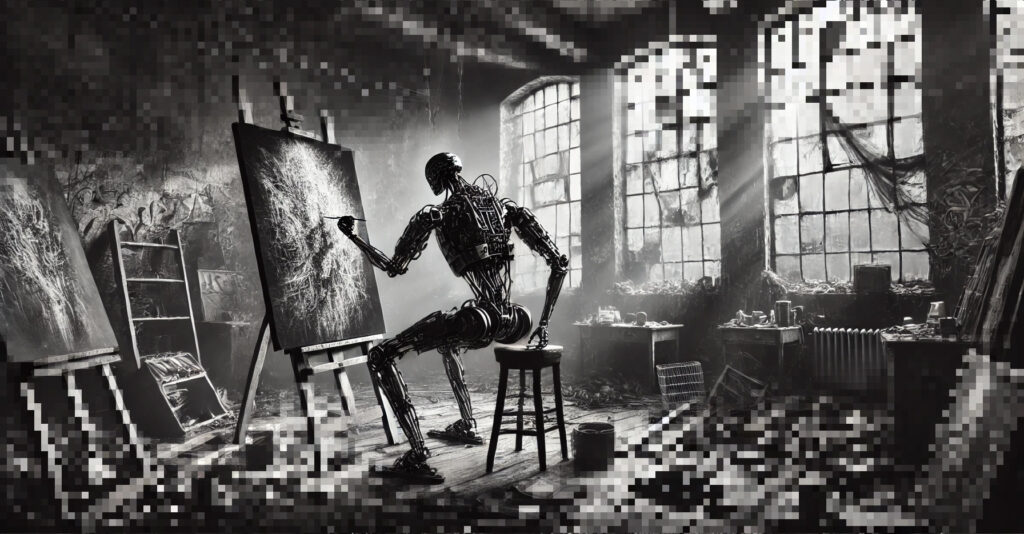
Some AI-generated works are the result of a deep partnership between human intent and machine processing. The human provides the seed of an idea, and the AI builds on it, expanding the creative process in ways the artist might not have imagined on their own. This collaborative creativity is an emerging trend, where AI acts as a creative assistant rather than a replacement for the human artist.
This raises an interesting dynamic: if AI becomes a partner in the creative process, can we still claim ownership over the art it helps create? Does a piece of art belong to the human who guided the AI, the machine that generated the content, or a combination of both?
Ethical Implications: Ownership, Authorship, and Originality
As AI-generated content becomes more prevalent, the question of authorship becomes murky. Who owns the rights to a piece of AI-generated art? The human who initiated the process? The developer of the AI model? Or is it public domain, given that it was created by a machine without consciousness or intent?
The issue of originality also arises. Since AI is trained on vast datasets of human-created content, is AI simply remixing and regurgitating human art, or is it creating something new? Some critics argue that AI creativity is inherently derivative, relying on the works of human artists to generate its own content. Others believe that AI’s ability to recombine ideas in novel ways still constitutes originality, much like how human artists draw inspiration from past works.
Additionally, there are concerns about the democratisation of creativity. As AI becomes more accessible, anyone can use these tools to generate impressive art, music, or literature. While this opens up creative opportunities for people without traditional artistic skills, it also raises concerns about devaluing human creativity. If machines can churn out high-quality creative content at scale, what does that mean for human artists and the value of their work?
The Future of Art: A Blurred Line Between Human and Machine
As AI continues to evolve, the distinction between human-created and machine-generated art will likely become increasingly blurred. In some cases, audiences may not even know whether a work was created by a human, an AI, or a combination of both. This raises fundamental questions about the nature of art itself: Is art defined by the intent of the creator? The emotional response it evokes? Or the process by which it is made?
In the future, we may see new forms of art that would not be possible without the involvement of AI. These creations could push the boundaries of what is aesthetically or conceptually possible, taking human imagination into previously uncharted territories. In this sense, AI may become not just a tool for human creativity but a co-creator, opening new frontiers in artistic expression.
Conclusion: Reimagining Creativity in the Age of AI
The rise of AI in the creative world challenges traditional notions of art, authorship, and creativity. As machines become more capable of generating complex, compelling works, we must rethink what it means to be creative. AI can’t replicate the personal, emotional experiences that fuel human creativity, but it can collaborate with human artists, expand creative possibilities, and generate new forms of artistic expression.
Ultimately, AI doesn’t diminish the value of human creativity; it enhances it. By embracing AI as a creative partner, we open up a new world of artistic potential—one where the line between human and machine art is blurred, but the power of creativity remains stronger than ever.


Leave a Reply