

SUBSTRATE.HOST began with a prohibition:
INTERIOR: INACCESSIBLE.
Not a gimmick — a rule.
That rule has shaped more than the Hosts themselves. It has shaped the instruments built around them.
Boundary Output asked one version of the problem: what does an inaccessible interior look like when it couples to a measurable world? Its answer was correlate, not content. Telemetry, not testimony. We instrument the boundary, not enter the room.
But building sound work around SUBSTRATE.HOST — albums like BLACK BOX LITURGY and BOUNDARY STUDIES — exposed a different absence. There was audio, but no equivalent visual instrument. Or rather: there were visual systems already in the project, but none that felt right for sound.
At first I thought the answer might be to sonify the existing Boundary Output modes. But that felt too derivative, as though one instrument were being asked to impersonate another.
Then a different form appeared:
a single enclosed string.
Closed, oscillating, deformable, sealed.
That turned out to be the better answer.
A perimeter under pressure
Boundary String is built around one simple condition:
the boundary can deform, but it does not rupture.
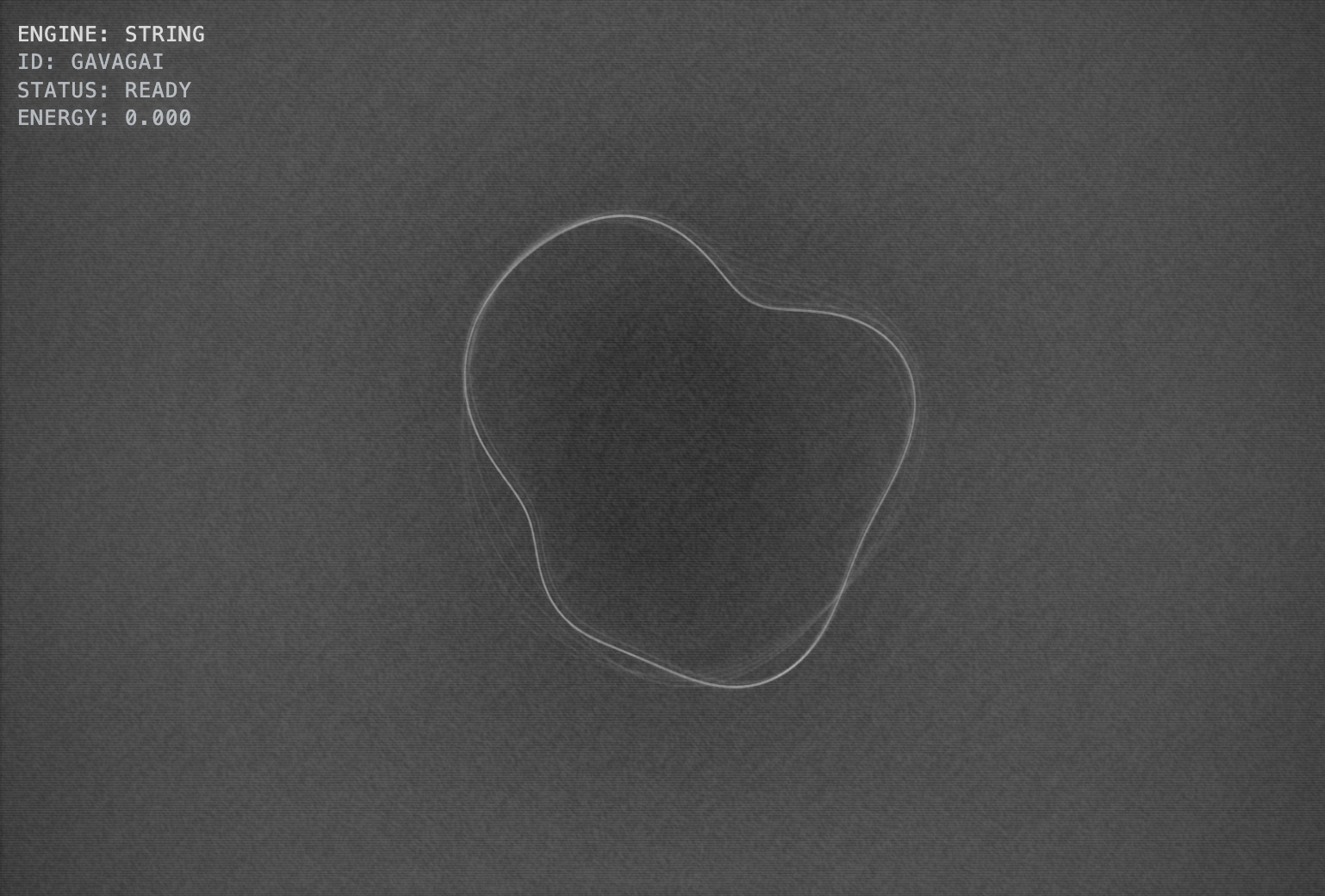
The uploaded sound file is not translated into image in any obvious visualiser sense. It acts instead as pressure on a closed form. The string twists, swells, drags, smears, and accumulates afterimage. It may appear to break, but the break is only ever perceptual. The line remains sealed.
That distinction matters.
The tool does not offer a window onto whatever lies “inside.” It stages the more interesting fact that something can be visibly stressed, publicly legible, and measurably disturbed without thereby becoming available in itself.
Again, the boundary is all we get.
Deformation, not disclosure
If Boundary Output is closest to the logic of a correlate — the public trace of a private event — then Boundary String is closer to a stress instrument.
It asks not “what signature does the inaccessible interior emit?” but:
what happens when a sealed limit is repeatedly acted upon?
The image does not claim to reveal mind, self, meaning, or hidden content. It stages deformation. It stages persistence. It stages the way a boundary retains the memory of recent pressure.
So the output is not revelation, but residue.
Ghosting, afterimage, smear: these do most of the philosophical work. Previous states do not disappear cleanly. The string leaves a trace of where it was a moment ago. The result is less a stable contour than a persistence field — a record of disturbance without access.
That is what makes the instrument interesting.
Memory as residue
The strongest behaviour in the current version is not the glitching. It is the ghosting.
There was a temptation early on to push harder toward rupture: tears, fractures, datamosh events, more dramatic instability. Some of that was useful. Most of it turned out to be noise in the wrong sense. The more the image behaved like an obvious event, the less it retained what was singular about it.
What remained compelling was quieter:
- the string dragging its own recent history behind it
- faint older states not fully decayed
- a sealed line behaving less like geometry than like stressed memory
The boundary became more than a shape. It became a persistence surface.
That is where the tool begins to align with concerns I’ve been circling elsewhere: memory as active trace rather than dead archive; residue rather than retrieval; previous states as still exerting force on the present.
Participation without entry
Boundary String also ended up feeling adjacent to participatory idealism, and to the GMB thesis in particular, though not in any literal illustrative sense.
The resemblance is structural.
The string is shaped by what acts upon it, but never becomes transparent. Light and dark operate here less as colours than as conditions of disclosure and withholding. The visible form is not a stable object but a boundary under continual re-formation. Memory persists as residue. The present expands through perturbation.
The instrument does not tell us what is inside. It shows what happens at the limit when forces act upon it.
That is enough.
Why a string?
There is also a useful superstring metaphor here, though only at the level of intuition.
A closed form whose significance lies in vibration rather than content.
Stress, oscillation, twist, frequency.
Not a little object with a hidden secret, but a boundary whose state becomes legible only through how it deforms.
I do not mean that literally, and the piece becomes weaker when pushed too far toward scientific illustration. Its strength comes from staying planar, minimal, and ambiguous. In that sense it feels less like physics visualisation than a kind of Flatland instrument: a two-dimensional perimeter behaving as though something is continually acting on it from angles we cannot quite occupy.
What Boundary String is (and isn’t)
Boundary String is not a conventional music visualiser.
It is not a waveform.
It is not a narrative animation.
It is not a diagram of what the track “means.”
It is not disclosure.
It is a concealed instrument for watching sound perturb a sealed edge.
Its controls can be adjusted — reactivity, twist, smear, glitch, levels, zoom, onset sensitivity — but the philosophical rule stays fixed:
the boundary is stressed, not opened.
The line moves.
The image remembers.
The interior remains unavailable.
A concealed instrument
Like the Protocol layer, Boundary String is not foregrounded in the public shell. It sits off to the side: accessible by direct route or valid command, but not presented as a first-layer page.
It is not a Host.
It is not a Token.
It is not a correlate generator in the same sense as Boundary Output.
It is a concealed auxiliary instrument:
a side-path pressure chamber for watching sound act on a limit that refuses to become a window.
Which, in the end, may be the most honest image I can make from it.
Tool link: https://substrate.host/boundary-string
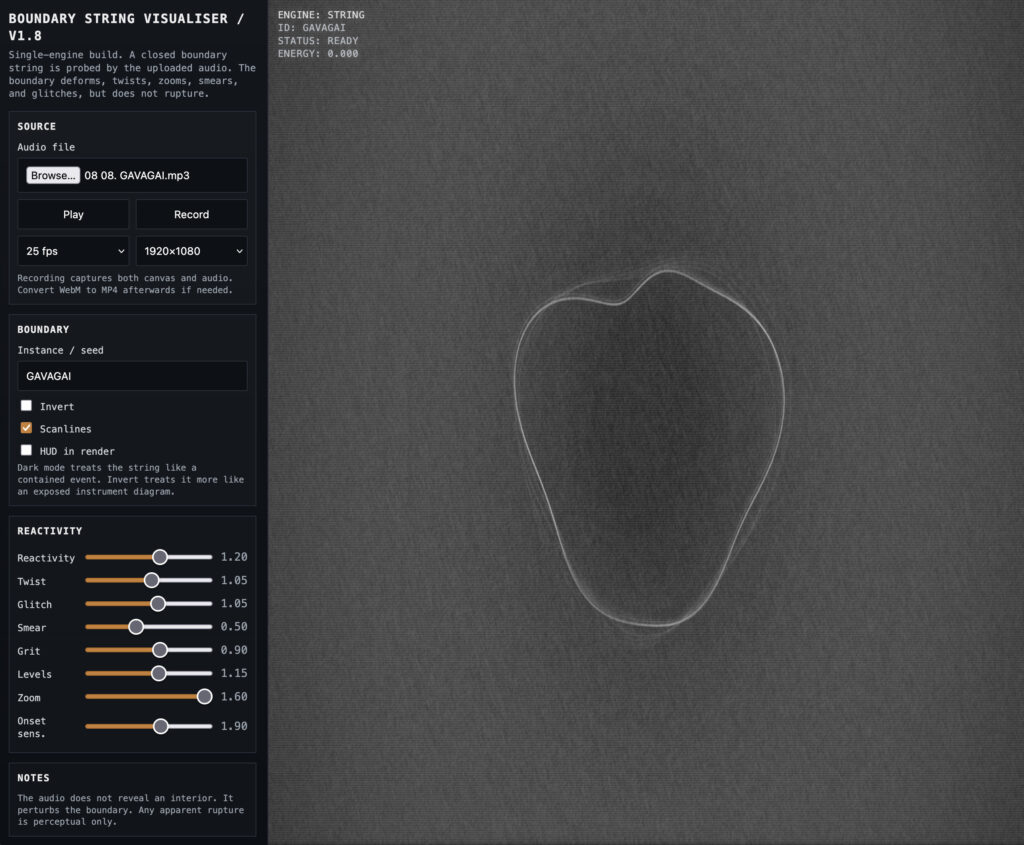
Boundary String lives as a standalone instrument-page on SUBSTRATE.HOST. Upload audio, perturb the sealed form, watch the boundary retain the memory of its own deformation.


Leave a Reply