

Winter Rules began as a quiet golf project.
That is still what it is.
But recently it has started to feel less like a new project and more like a place where older questions have begun reappearing without invitation.
The first clue was the emptiness.
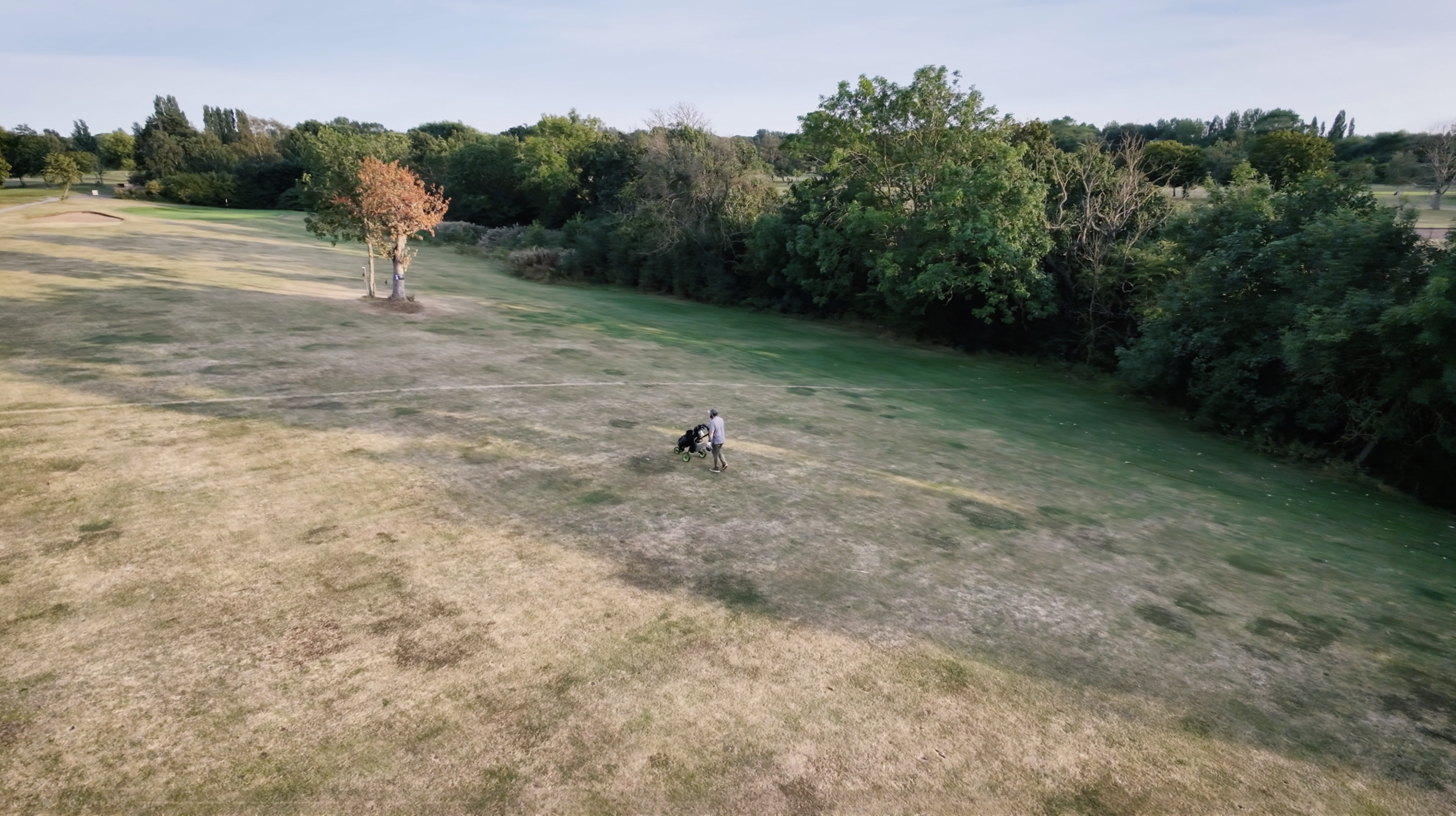
After dozens of videos, I realised how rarely another person appears in Winter Rules footage. The golf course is functioning. The fairways are cut. Flags remain in holes. Range bays wait to be occupied. Signs still instruct people how to behave.
But almost nobody is there.
A lone golfer moves through a maintained landscape that often appears strangely abandoned.
Not post-apocalyptic in the obvious sense.
No ruins. No fires. No catastrophe.
Just infrastructure without population.
The world remains.
The people seem to have gone.
That visual language felt familiar.
Narrata has repeatedly returned to solitary figures moving through emptied or unstable environments.
In Traceback Error, an android crosses a ruined world carrying fragments of human memory it cannot fully understand.
In The Zero Point, the Wanderer continues through a landscape whose boundaries, time and physical rules are gradually failing.
In Fates of the Forgotten, Calder walks through the aftermath of collapse and confronts a choice between surrendering to instability and continuing despite it.
In The Last Observer, a solitary witness remains at the end of the universe, watching the final boundary between what can be known and what lies beyond it.
Different stories.
Different worlds.
But the figure keeps returning.
Someone walks.
Someone watches.
Something remains unresolved.
Winter Rules appears to have placed that figure on a golf course.
The overlap became harder to ignore once the cameras acquired names.
Stile watches from the ground.
Corvid watches from above.
Mimir listens.
Others may follow.
These names began as a practical and playful way of distinguishing equipment, but the language of observers arrived almost accidentally.
That too was already present in Narrata.
Observation, black boxes, inaccessible interiors, machine perception, unreliable evidence, boundaries between experience and measurement.
Again, nothing was consciously imported.
It simply reappeared.
Even the practical problems of filming began to reproduce older questions.
Recording a golf round changes the round.
Attention moves from the shot to the camera.
A drone reveals relationships invisible from the ground, while simultaneously creating new distractions.
Footage documents an event while failing to reproduce what the event felt like.
Some moments become more interesting only because something went wrong.
And occasionally the act of capturing the experience interferes with the experience itself.
That last problem feels particularly familiar.
In Glyph in the Murder, a sound designer encounters a phenomenon that exists only while he observes it directly. Every attempt to record it produces ordinary evidence. Eventually he stops trying to capture the event and simply watches.
Winter Rules has begun to produce the opposite version of the same problem.
The event can be recorded.
But the observer may become so occupied with recording it that the event itself becomes harder to experience.
The distinction between experience and evidence remains.
Only the direction has changed.
This connects to something else that has followed Narrata for years: control.
Many of its stories contain systems designed to make reality more orderly, more measurable, more predictable.
Those systems usually fail.
The instability remains.
Winter Rules arrived at a much simpler formulation from golf.
Conditions are imperfect.
Adjustments are allowed.
Play continues anyway.
The phrase was never intended as a philosophical thesis.
But increasingly it feels like a compressed version of one.
Not optimism.
Not fatalism.
Something between them.
The conditions will not become perfect simply because we would prefer them to.
Nor does imperfection make action meaningless.
You assess what is there.
You adjust.
You continue.
That same position appears repeatedly in the older fiction.
The world collapses.
The storm arrives.
The machine fails.
The evidence is incomplete.
The answer remains inaccessible.
And still someone walks forward.
Perhaps that is why Winter Rules has absorbed so many apparently unrelated interests so easily.
Photography.
Film.
Sound.
Deafness and perception.
Artificial intelligence.
Robotics.
Old technology.
Weather.
Walking.
Municipal landscapes.
Even the strange contrast between increasingly autonomous machines and deliberately old, material objects.
None of these need to become subjects of Winter Rules.
Most probably shouldn’t.
The golf project works better if these ideas remain latent.
A viewer does not need to know that The Last Observer exists in order for an empty golf course to feel slightly uncanny.
Corvid does not need to become a metaphor for machine perception.
A future camera robot does not need an explanation.
The image can carry the residue without carrying the argument.
Narrata can do the noticing afterwards.
That may be the useful distinction between the two projects.
Winter Rules remains the field.
Narrata remains the notebook.
One produces events.
The other notices patterns.
The earlier field note ended with the thought that some ideas cannot be developed in software.
They have to be walked.
Perhaps there is another part to that.
Some ideas are walked before we realise we have begun thinking about them again.
Winter Rules did not deliberately inherit these older questions.
It created the conditions in which they could return.
The observer, apparently, was already waiting.


Leave a Reply