

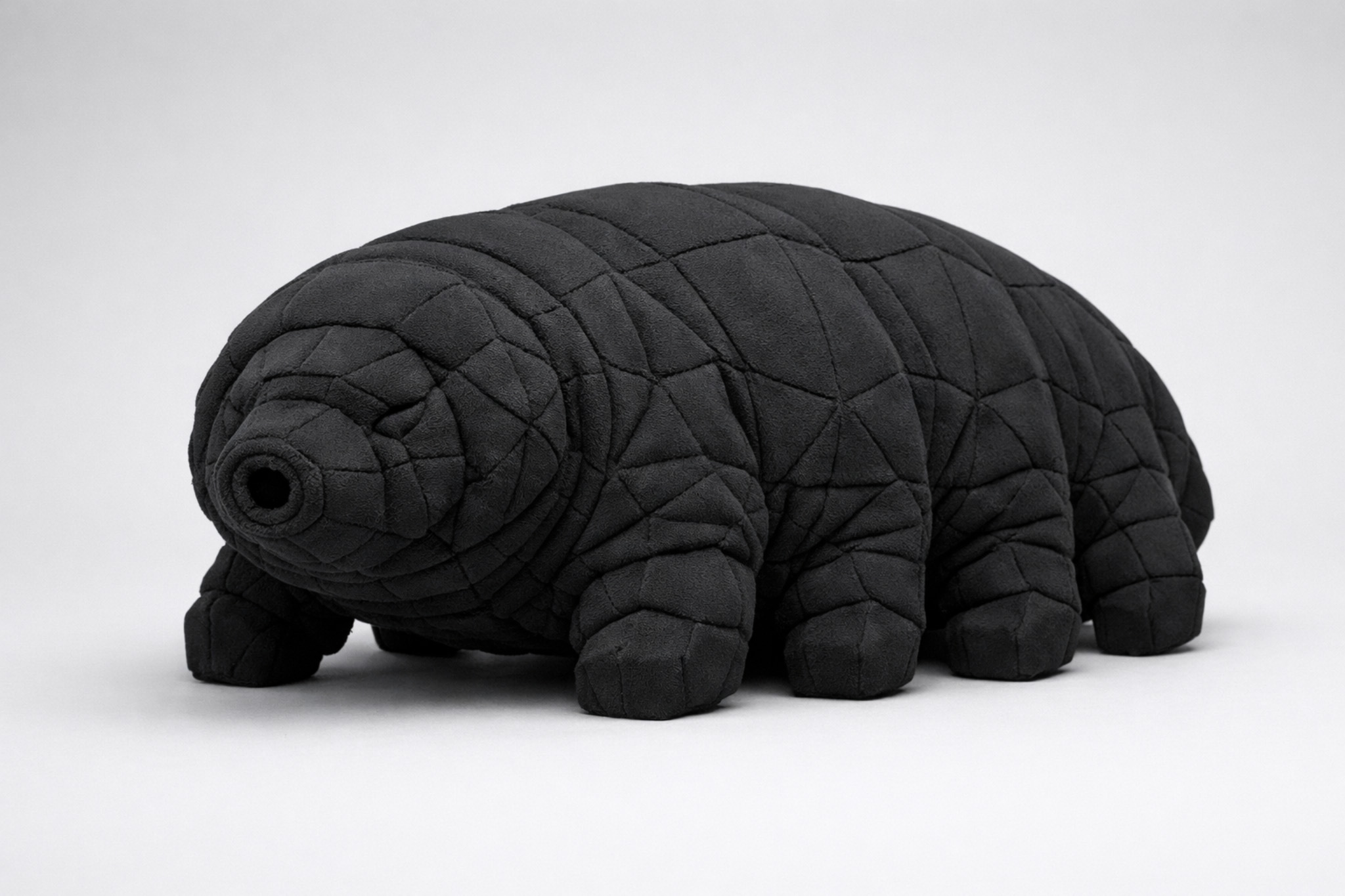
When I first wrote about SUBSTRATE.HOST in February (here), I described it as “a boundary you can keep on your desk.” That was the right first framing: a way of talking about the project at the moment it stopped being only theory and started becoming object.
Since then, the system has become more structurally defined. What began around a single Host now includes clearer distinctions between object classes, stateful NFC endpoints, archival logic, and a broader understanding of what ownership within the system actually means.
So this is a follow-up, and a clarification.
Not a replacement for the earlier post, but a more stable description of what SUBSTRATE.HOST is now: what kind of system it is, how it works, and what it is trying to make tangible.
What it is
SUBSTRATE.HOST is a system of physical artefacts linked to remote identity layers through NFC.
Some of these objects are sealed forms that suggest an interior without revealing one. Others are simpler relay objects that act as markers, carriers, or pointers. In both cases, the physical object remains materially unchanged while a scan resolves to an external record tied to a specific instance.
The project sits somewhere between object design, interface design, and philosophy. It is concerned with a simple but difficult condition: that what matters most about a thing may shape our relation to it without ever becoming fully accessible.
SUBSTRATE does not try to solve that condition. It turns it into form.
The core idea
We never fully access another interior directly.
Whether we are dealing with another person, an animal, a machine, or even ourselves, we work through surface: behaviour, signal, expression, trace, response. We infer. We model. We get closer or further away. But we do not simply open the thing and retrieve its inside in any complete sense.
SUBSTRATE takes that condition of partial access and makes it tangible.
The objects are designed to stage the limit between presence and disclosure. They ask what it means to relate to something that is clearly there, clearly active, and yet still not fully available.
Host vs Token
SUBSTRATE currently works across two main object classes: Hosts and Tokens.
Hosts
Hosts are sealed objects that imply interiority without revealing it.
They are designed to feel like contained presences: forms that invite inference, attachment, projection, or interpretation, while refusing direct disclosure. A Host is not a chatbot, a smart toy, or a simulated person. It is a physical object that stages the experience of relating to something that seems to have an inside while keeping that inside unavailable.
Current examples include:
- VESSEL-9 — a reversible cephaloid Host that flips between two ontological states
- SILT-12 — a faceted liminal-fauna Host with a denser, specimen-like presence
Tokens
Tokens do not imply a contained being.
They are interface-only objects: markers, relay surfaces, worn or carried artefacts that point outward to a remote identity layer without presenting themselves as bodies or creatures. Where a Host is container-like, a Token is more procedural. It does not perform interiority; it formalises boundary, contact, and relay.
Current examples include:
- SUBLIMINAL — wearable tokens such as caps or beanies
- NULL — off-body sealed relay objects such as resin blocks with embedded NFC
This distinction matters. A Host is meant to be encountered as a sealed presence. A Token is meant to be encountered as a relay.
How NFC works
Each SUBSTRATE object contains an embedded NFC tag.
That tag does not store a mind, personality, or interior. It stores a reference: a pointer to a remote endpoint tied to a specific object instance.
The basic structure is simple:
- the tag stores a reference
- the system stores the identity layer
- the object remains sealed
When scanned, the object resolves to a page or endpoint associated with that individual instance. That endpoint may contain identity information, state changes, observational records, or other forms of external documentation. The physical object itself does not change. It remains what it is: a silent carrier of a relation.
This matters conceptually as well as technically. The system is built so that the “inside” is never simply located in the body of the object. The object points outward. The relation happens across a boundary.
What ownership means
Owning a SUBSTRATE object does not mean unlocking hidden content or gaining privileged access to an interior.
It means holding a sealed artefact linked to a remote identity layer.
Ownership in SUBSTRATE is therefore relational rather than extractive. You do not open the object. You do not retrieve its essence. You keep it, carry it, scan it, return to it, and accumulate a history of contact with it over time.
What ownership grants is not disclosure, but relation:
- a specific instance
- a persistent identifier
- a remote endpoint
- a structured encounter with an object that remains materially closed
This is part of the point. The project pushes back, quietly, against the assumption that value always lies in access, transparency, or extraction. Sometimes relation is structured precisely by what remains unavailable.
Object classes and form logic
SUBSTRATE objects are not organised only by product category. They are organised by containment logic.
A Host is an object whose form implies a contained interior.
A Token is an object whose form implies relay, marker, or interface.
Within those two classes, objects can take different types or form factors.
A type describes the kind of being or structure being implied.
Examples: cephaloid, liminal fauna.
A form factor describes how that implication is physically carried.
Examples: reversible soft shell, faceted soft shell, wearable token, sealed resin block.
This allows the system to grow without collapsing everything into character design, merch, or gadget logic. Each object should strengthen the same basic condition: surface is present, relation is real, interior remains inaccessible.
Why opacity matters
SUBSTRATE is not built around “mystery” in a vague atmospheric sense. It is built around opacity as a basic condition of relation.
In technology and design culture, there is often an assumption that more access is always better: more data, more legibility, more visibility, more extraction. But many meaningful relations do not work that way. They are structured by inference, distance, asymmetry, delay, projection, and partial access.
Opacity is not only a lack. It can also be a condition of dignity, boundary, pressure, and form.
SUBSTRATE treats that as design material.
The project was sharpened by contemporary AI, because AI intensifies the experience of relating to something behaviourally rich whose inner status remains difficult to settle. But the underlying issue is older than AI. Human minds were already black boxes to each other. The body was already a partial relay rather than a transparent container. SUBSTRATE extends that older condition into object form.
What it is not
SUBSTRATE is not:
- a claim that these objects are conscious
- a chatbot platform
- a digital pet system
- a therapeutic device
- a biometric or surveillance product
- a proof of any metaphysical theory
It is better understood as a tactile philosophy platform, or a designed system for thinking about relation under conditions of non-disclosure.
The objects are not there to explain a thesis in abstract terms. They are there to make a specific conceptual limit feel present, portable, and difficult to ignore.
Why it exists
SUBSTRATE exists to make a familiar but often overlooked condition more legible: that interiors may be real, active, and consequential without ever becoming fully available from the outside.
The system gives that condition a material form. A sealed Host. A wearable marker. A buried relay. A remote endpoint. A record of contact. A boundary that can be encountered without being crossed.
It is not a solution. It is a construction built around the limit itself.
The site itself remains colder than this summary by design. The shell is procedural. The objects remain sealed. The endpoints remain partial. But at a certain point a system needs a plain description of itself.
This is that description.


Leave a Reply