

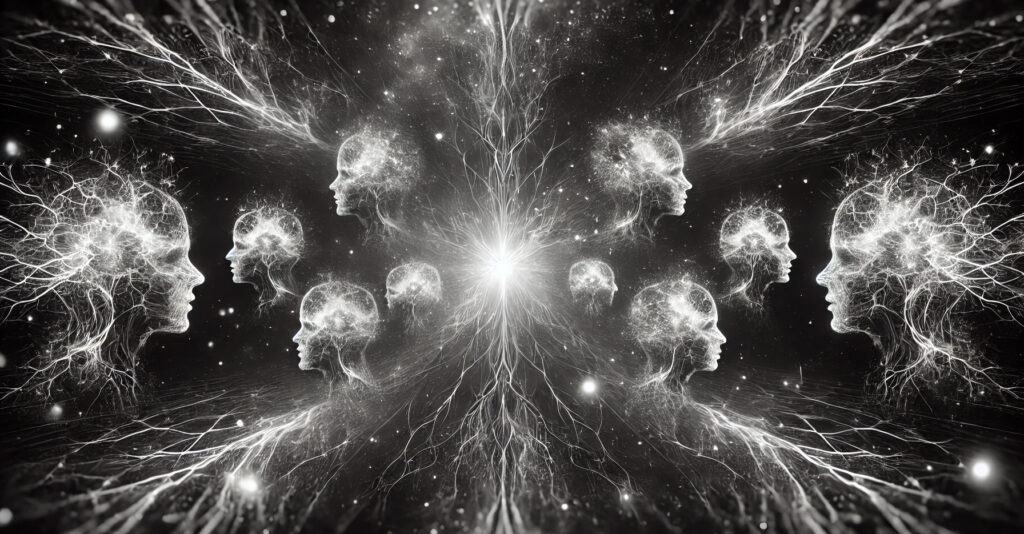
The intersection of quantum mechanics and consciousness is one of the most intriguing frontiers of modern science and philosophy. While traditionally considered separate fields, recent theories suggest that the quantum realm might hold the key to understanding the nature of consciousness and individuality. Here’s a deeper dive into this concept:
Quantum Mechanics and Consciousness: The Overlap
Quantum mechanics reveals a universe where particles exist in states of superposition, entangled across vast distances, and influenced by observation. These phenomena raise profound questions about the role of the observer and the nature of reality itself, leading some to speculate that consciousness might be linked to quantum processes.
Key Concepts in Quantum Mechanics
- Superposition: Particles exist in multiple states until observed, collapsing into a single outcome.
- Entanglement: Two particles remain connected, such that the state of one instantly affects the other, no matter the distance.
- Observer Effect: The act of measurement alters the system being observed, implying a fundamental connection between the observer and the observed.
The Quantum Self: A New Framework for Identity
Traditional views of the self consider it as an individual, isolated entity. However, quantum mechanics challenges this notion by suggesting interconnectedness at a fundamental level. The “Quantum Self” theory posits that consciousness might function as a networked, entangled phenomenon.
Implications for Individuality
- Entangled Minds: If consciousness operates quantum mechanically, individuals might not be entirely separate. Instead, minds could be “entangled,” subtly influencing each other across space and time.
- Non-Local Identity: Identity might extend beyond the brain, existing as a quantum field that interacts with the environment, akin to the way entangled particles operate.
- Superposition of Self: The self might not be a fixed, singular entity but exist in a state of potentiality, influenced by observation and experience.
Theories Bridging Quantum Physics and Consciousness
Several hypotheses attempt to explain the potential link between the quantum world and consciousness:
- Orchestrated Objective Reduction (Orch-OR)
Proposed by physicist Roger Penrose and anesthesiologist Stuart Hameroff, this theory suggests that consciousness arises from quantum processes in microtubules within brain cells. These processes might explain the mysterious unity of conscious experience. - Quantum Brain Dynamics (QBD)
This theory posits that quantum effects in the brain’s neural activity could play a role in consciousness, offering an explanation for phenomena like intuition, creativity, and the “aha” moment. - Universal Consciousness and Quantum Field Theory
Some speculative frameworks propose that consciousness is a universal phenomenon—akin to a quantum field—connecting all beings. This aligns with philosophical ideas of a “collective unconscious” or “cosmic mind.”
Entangled Consciousness and the Observer Effect
The observer effect in quantum mechanics implies a deep relationship between the act of observation and the state of reality. Could consciousness itself be the ultimate observer, shaping the universe at a fundamental level?
- Consciousness as the Observer: This idea suggests that the act of observing is not just a passive experience but a creative force that shapes reality.
- Feedback Loop of Reality: If consciousness collapses quantum states into reality, the universe might be a participatory construct, with observers entangled in its evolution.
Philosophical Implications
- Unity of Existence: If consciousness is entangled, individuality might be an illusion. We could be fragments of a singular, interconnected awareness.
- Free Will and Determinism: Quantum mechanics introduces probabilistic outcomes, potentially reconciling free will with the deterministic nature of classical physics.
- The Nature of Reality: If consciousness influences reality, then materialism—the view that the universe is purely physical—might be incomplete. This opens the door to idealism, the idea that reality is fundamentally mental.
Quantum Consciousness in Popular Culture
Explore how these ideas are reflected in films, shows, and literature. Stories like Donnie Darko, Coherence, and The Matrix delve into themes of interconnected minds, observer-driven reality, and the malleability of identity. These narratives resonate with the quantum-consciousness debate, offering imaginative takes on the mysteries of existence.
Conclusion
While the quantum-consciousness connection remains speculative, it invites profound questions about individuality, interconnectedness, and the role of the observer in shaping reality. By exploring these intersections, we gain not only scientific insights but also a deeper understanding of what it means to exist.
USEFUL LINKS AND FURTHER READING
“Groundbreaking Study Affirms Quantum Basis for Consciousness: A Paradigm Shift in Understanding Human Nature”
This article discusses recent research suggesting that anaesthesia works by binding to microtubules inside neurons, providing evidence for a quantum theory of consciousness.
“Does Consciousness Explain Quantum Mechanics?”
This piece explores the theory that consciousness may play a role in determining the state of subatomic particles, thereby influencing quantum mechanics.
“Quantum Entanglement in Neurons May Actually Explain Consciousness”
This article examines the hypothesis that quantum entanglement within neurons could be fundamental to the emergence of consciousness.
“Experiments Prepare to Test Whether Consciousness Arises from Quantum Processes”
This article outlines upcoming experiments aimed at determining if consciousness originates from quantum processes, including the potential enhancement of consciousness through engineered quantum states.
“Quantum Mind”
This Wikipedia entry provides an overview of various hypotheses proposing that quantum-mechanical phenomena may play a crucial role in the functioning of the brain and the emergence of consciousness.


Leave a Reply